罕 (hǎn) means "Rare" in Chinese. It has 7 strokes with the radical 罒, and is HSK Level 7.
Rated 3.5/5 in difficulty (challenging).
Harder than 21% of HSK Level 7 characters.
Appears in 3+ common words including 罕见 (hǎn jiàn), 稀罕 (xī hǎn), 罕有 (hǎn yǒu).
Due to its 7 strokes, Hanzi Writer's error detection shows 罕 requires focused practice — most learners need 10+ attempts for consistent accuracy.
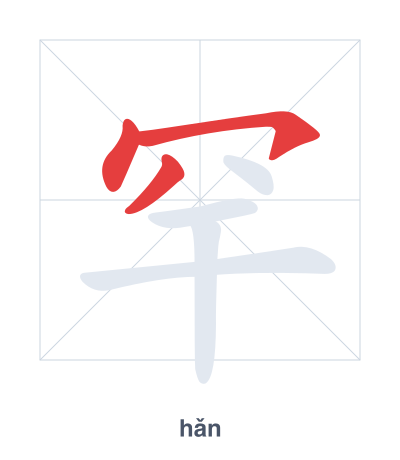
Open Hanzi Writer to see the animated stroke order and practice writing 罕 with real-time feedback.
The character 罕 (hǎn) is written with 7 strokes. Follow the standard Chinese stroke order: top to bottom, left to right, outside before inside. The radical 罒 is one of its key components.
Practice the correct stroke order with the Hanzi Writer app to see animated stroke-by-stroke guidance with real-time feedback.
罕 means Rare.
As an HSK Level 7 character, 罕 is an intermediate-level character.
罕 originally depicted a net (罒) attached to a long pole (干), used for catching birds. This specialized tool was not commonly employed, so the character extended to mean 'rare'.
💡 Memory Tip: Picture a rare net (罒) kept dry (干) on a pole because it's too precious to use often.
这种花很罕见。
zhè zhòng huā hěn hǎn jiàn
This flower is very rare.
我不稀罕这个。
wǒ bù xī hǎn zhè ge
I don't care for this.
这个机会很罕有。
zhè ge jī huì hěn hǎn yǒu
This opportunity is very rare.
Open Hanzi Writer to see the animated stroke order and practice writing 罕 with real-time feedback.
✨ Animated stroke order · Handwriting recognition · HSK-graded practice · Free to use
The character 罕 combines the radical 罒 (net) on top with 干 (dry or stem) below. The net radical suggests catching or covering, while 干 provides a phonetic hint for the pronunciation hǎn. The meaning 'rare' may come from the idea that something is hard to catch in a net, though the exact origin is not certain.