额 (é) means "Forehead; amount" in Chinese. It has 15 strokes with the radical 页, and is HSK Level 6.
Rated 4.2/5 in difficulty (advanced).
Harder than 100% of HSK Level 6 characters.
Appears in 3+ common words including 额头 (é tóu), 名额 (míng é), 余额 (yú é).
Due to its 15 strokes, Hanzi Writer's error detection shows 额 requires focused practice — most learners need 10+ attempts for consistent accuracy.
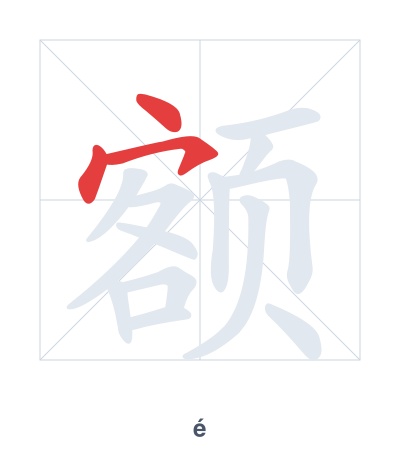
Open Hanzi Writer to see the animated stroke order and practice writing 额 with real-time feedback.
The character 额 (é) is written with 15 strokes. Follow the standard Chinese stroke order: top to bottom, left to right, outside before inside. The radical 页 is one of its key components.
Practice the correct stroke order with the Hanzi Writer app to see animated stroke-by-stroke guidance with real-time feedback.
额 means Forehead; amount.
As an HSK Level 6 character, 额 is an intermediate-level character.
额 is a semantic-phonetic compound: the radical 页 (head) indicates the meaning relates to the head, while the component 客 (guest) provides the pronunciation. Its original meaning is 'forehead', the foremost part of the head.
💡 Memory Tip: Picture a guest (客) with an unusually large forehead (页) bowing slightly as they enter, making you notice their forehead first.
他的额头很高。
tā de é tóu hěn gāo
He has a high forehead.
比赛名额有限。
bǐ sài míng é yǒu xiàn
The number of spots for the competition is limited.
银行卡余额不足。
yín háng kǎ yú é bù zú
Insufficient balance on the bank card.
Open Hanzi Writer to see the animated stroke order and practice writing 额 with real-time feedback.
✨ Animated stroke order · Handwriting recognition · HSK-graded practice · Free to use
额 is made of two parts: the left side 客 (kè, guest) and the right side 页 (yè, head/page). The right side 页 indicates the head area, so the character originally means 'forehead'. The left side 客 gives the pronunciation é and has no direct connection to the meaning.