颓 (tuí) means "decadent / ruined / dejected" in Chinese. It has 13 strokes with the radical 页, and is HSK Level 7.
Rated 4.2/5 in difficulty (advanced).
Harder than 97% of HSK Level 7 characters.
Appears in 3+ common words including 颓废 (tuí fèi), 颓丧 (tuí sàng), 颓势 (tuí shì).
Due to its 13 strokes, Hanzi Writer's error detection shows 颓 requires focused practice — most learners need 10+ attempts for consistent accuracy.
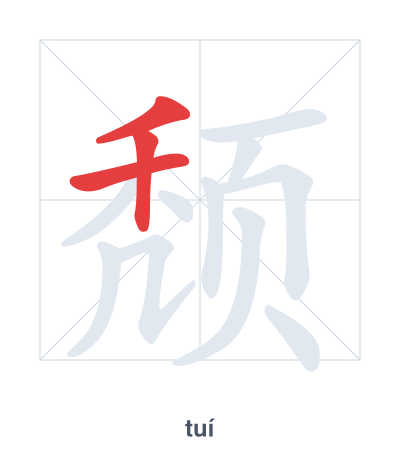
Open Hanzi Writer to see the animated stroke order and practice writing 颓 with real-time feedback.
The character 颓 (tuí) is written with 13 strokes. Follow the standard Chinese stroke order: top to bottom, left to right, outside before inside. The radical 页 is one of its key components.
Practice the correct stroke order with the Hanzi Writer app to see animated stroke-by-stroke guidance with real-time feedback.
颓 means decadent / ruined / dejected.
As an HSK Level 7 character, 颓 is an intermediate-level character.
颓 combines 秃 (bald) and 页 (head), literally 'bald head'. Since hair loss often accompanies aging or illness, the image evokes decline, ruin, or a dejected state.
💡 Memory Tip: Picture a bald man (秃) slumping his head (页) in despair — his receding hairline mirrors his ruined spirit.
他最近看起来很颓废。
tā zuì jìn kàn qǐ lái hěn tuí fèi
He looks very dispirited lately.
考试没考好,他很颓丧。
kǎo shì méi kǎo hǎo tā hěn tuí sàng
He is very dejected because he didn't do well on the exam.
球队终于扭转了颓势。
qiú duì zhōng yú niǔ zhuǎn le tuí shì
The team finally reversed the decline.
Open Hanzi Writer to see the animated stroke order and practice writing 颓 with real-time feedback.
✨ Animated stroke order · Handwriting recognition · HSK-graded practice · Free to use
颓 is composed of 秃 meaning 'bald' on the left and 页 meaning 'head' on the right. Together they suggest a balding head, which visually represents decline or loss of vigor, linking to the meanings of decadent, ruined, or dejected.