颐 (yí) means "cheek / jaw / to nourish" in Chinese. It has 13 strokes with the radical 页.
Rated 4.2/5 in difficulty (advanced).
Appears in 3+ common words including 颐和园 (yí hé yuán), 大快朵颐 (dà kuài duǒ yí), 颐养 (yí yǎng).
Due to its 13 strokes, Hanzi Writer's error detection shows 颐 requires focused practice — most learners need 10+ attempts for consistent accuracy.
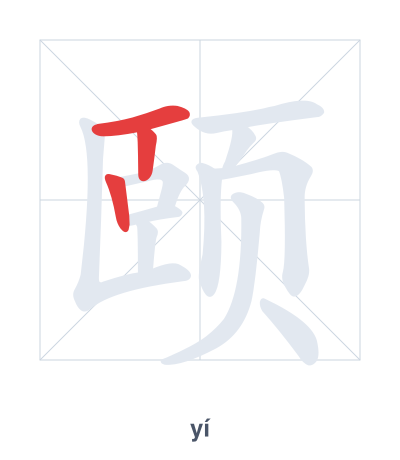
Open Hanzi Writer to see the animated stroke order and practice writing 颐 with real-time feedback.
The character 颐 (yí) is written with 13 strokes. Follow the standard Chinese stroke order: top to bottom, left to right, outside before inside. The radical 页 is one of its key components.
Practice the correct stroke order with the Hanzi Writer app to see animated stroke-by-stroke guidance with real-time feedback.
颐 means cheek / jaw / to nourish.
The character 颐 combines the radical 页 (head) with a component showing a mouth (口) inside an enclosure (匚), representing the jaw or cheek area. Its ancient form depicted the side of the face, and later it extended to the meaning 'to nourish' (as in 颐养).
💡 Memory Tip: Picture a cheek (页) with a mouth (口) inside a box (匚) being gently nourished by spoonfuls of soup.
颐和园的风景非常美。
yí hé yuán de fēng jǐng fēi cháng měi
The scenery of the Summer Palace is very beautiful.
我们在餐厅里大快朵颐。
wǒ men zài cān tīng lǐ dà kuài duǒ yí
We are feasting in the restaurant.
爷爷在乡下颐养天年。
yé yé zài xiāng xià yí yǎng tiān nián
Grandpa is enjoying his retirement in the countryside.
Open Hanzi Writer to see the animated stroke order and practice writing 颐 with real-time feedback.
✨ Animated stroke order · Handwriting recognition · HSK-graded practice · Free to use
颐 is composed of the radical 页 (page/head) on the right and a left component 匚 (box) with 口 (mouth) inside. The head radical links to the cheek/jaw area, while the mouth in a box can represent nourishing or feeding.