余 (yú) means "surplus; remainder; I (formal)" in Chinese. It has 7 strokes with the radical 人, and is HSK Level 4.
Rated 3.2/5 in difficulty (challenging).
Harder than 16% of HSK Level 4 characters.
Appears in 3+ common words including 业余 (yè yú), 剩余 (shèng yú), 多余 (duō yú).
Due to its 7 strokes, Hanzi Writer's error detection shows 余 requires focused practice — most learners need 10+ attempts for consistent accuracy.
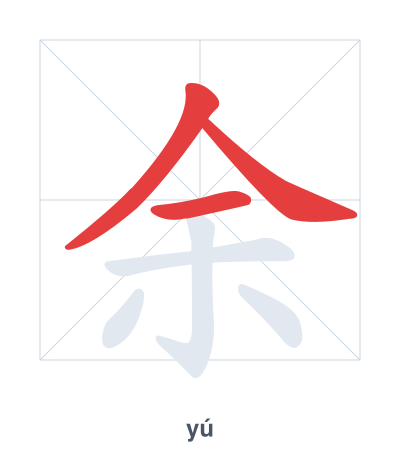
Open Hanzi Writer to see the animated stroke order and practice writing 余 with real-time feedback.
The character 余 (yú) is written with 7 strokes. Follow the standard Chinese stroke order: top to bottom, left to right, outside before inside. The radical 人 is one of its key components.
Practice the correct stroke order with the Hanzi Writer app to see animated stroke-by-stroke guidance with real-time feedback.
余 means surplus; remainder; I (formal).
As an HSK Level 4 character, 余 is an intermediate-level character.
In ancient scripts, 余 depicted a simple house with a roof (亼) and a crossbeam, symbolizing a structure that provides extra space, thus 'surplus' or 'remainder.' The formal first-person pronoun 'I' is a phonetic loan unrelated to this original meaning.
💡 Memory Tip: A person (人) stands beside an altar (示) piled with leftover offerings, representing the surplus (余) they have.
他业余时间喜欢看书。
tā yè yú shí jiān xǐ huān kàn shū
He likes reading in his spare time.
盘子里还有剩余的菜。
pán zi lǐ hái yǒu shèng yú de cài
There are still leftovers on the plate.
这句话是多余的。
zhè jù huà shì duō yú de
This sentence is redundant.
Open Hanzi Writer to see the animated stroke order and practice writing 余 with real-time feedback.
✨ Animated stroke order · Handwriting recognition · HSK-graded practice · Free to use
The character 余 has the radical 人 (person) on top and a simplified form of 禾 (grain) below. The combination suggests a person having extra grain, which leads to the meanings of "surplus" or "remainder." It also serves as a formal first-person pronoun "I" in classical-style writing.