丈 (zhàng) means "zhang (unit of length, approx. 3.33m); husband; elder male relative" in Chinese. It has 3 strokes with the radical 一, and is HSK Level 4.
Rated 2.2/5 in difficulty (moderate).
Harder than 1% of HSK Level 4 characters.
Appears in 3+ common words including 丈夫 (zhàng fū), 丈量 (zhàng liáng), 丈母娘 (zhàng mǔ niáng).
Hanzi Writer's stroke validation shows learners typically need 5-8 attempts to write 丈 with correct proportion and order.
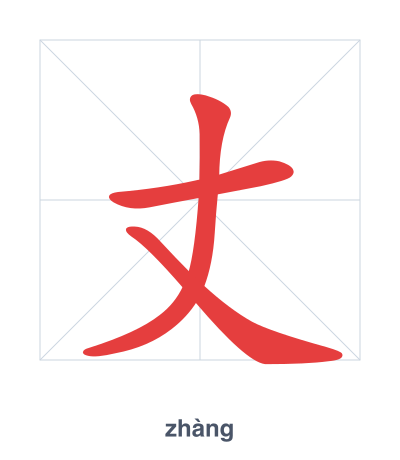
Open Hanzi Writer to see the animated stroke order and practice writing 丈 with real-time feedback.
The character 丈 (zhàng) is written with 3 strokes. Follow the standard Chinese stroke order: top to bottom, left to right, outside before inside. The radical 一 is one of its key components.
Practice the correct stroke order with the Hanzi Writer app to see animated stroke-by-stroke guidance with real-time feedback.
丈 means zhang (unit of length, approx. 3.33m); husband; elder male relative.
As an HSK Level 4 character, 丈 is an intermediate-level character.
Originally depicted a man (大) with a horizontal line at waist height, representing the measure of one zhang (about 3.33 meters). The modern form evolved into a horizontal stroke (一) above a crossed figure (乂), symbolizing a person holding a measuring stick.
💡 Memory Tip: Imagine a horizontal measuring stick (一) held by a crossed figure (乂) of a man, marking exactly one zhang in length.
她的丈夫在医院工作。
tā de zhàng fū zài yī yuàn gōng zuò
Her husband works at a hospital.
老师在丈量桌子的长度。
lǎo shī zài zhàng liáng zhuō zi de cháng dù
The teacher is measuring the length of the table.
他的丈母娘对他很好。
tā de zhàng mǔ niáng duì tā hěn hǎo
His mother-in-law is very kind to him.
Open Hanzi Writer to see the animated stroke order and practice writing 丈 with real-time feedback.
✨ Animated stroke order · Handwriting recognition · HSK-graded practice · Free to use
丈 is made of a horizontal stroke on top and two diagonal strokes crossing below, resembling a person holding a measuring tool. This shape connects to its meaning as a unit of length (about 3.33 meters) and by extension to a 'husband' or 'elder male relative', as a man was seen as the 'measure' of a family.