七 (qī) means "seven" in Chinese. It has 2 strokes with the radical 一, and is HSK Level 1.
Rated 1.4/5 in difficulty (beginner-friendly).
Harder than 2% of HSK Level 1 characters.
Appears in 3+ common words including 七个 (qī gè), 七月 (qī yuè), 七点 (qī diǎn).
In the Hanzi Writer app, most learners master 七 within 3 practice attempts using stroke-by-stroke animation.
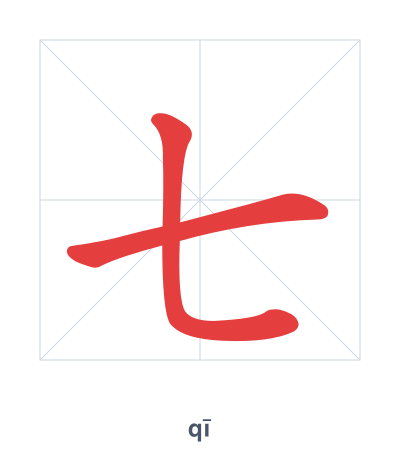
Open Hanzi Writer to see the animated stroke order and practice writing 七 with real-time feedback.
The character 七 (qī) is written with 2 strokes. Follow the standard Chinese stroke order: top to bottom, left to right, outside before inside. The radical 一 is one of its key components.
Practice the correct stroke order with the Hanzi Writer app to see animated stroke-by-stroke guidance with real-time feedback.
七 means seven.
As an HSK Level 1 character, 七 is among the first characters beginners learn.
The ancient form of 七 was a pictograph of a cut mark, showing a vertical line with a short horizontal line crossing it near the top, representing an incision. It originally meant 'to cut' but was later borrowed to mean the number seven. The modern shape simplifies to a horizontal stroke and a bent vertical stroke.
💡 Memory Tip: Imagine a horizontal line (the ground) with a vertical stick bent at the bottom like a hook, forming the shape of the digit 7—your walking stick for seven steps.
我有七个苹果。
wǒ yǒu qī gè píng guǒ
I have seven apples.
七月的天气很热。
qī yuè de tiān qì hěn rè
The weather in July is very hot.
我们七点见面吧。
wǒ men qī diǎn jiàn miàn ba
Let's meet at seven.
Open Hanzi Writer to see the animated stroke order and practice writing 七 with real-time feedback.
✨ Animated stroke order · Handwriting recognition · HSK-graded practice · Free to use
The character 七 consists of just two strokes: a horizontal stroke (一, the radical meaning 'one') and a vertical hook stroke (乚). Although it looks simple, the two strokes together form an abstract shape that represents the number seven. The radical '一' is a clue to its straightforward, single-unit structure.