丁 (dīng) means "man; small cube (of food); the fourth Heavenly Stem" in Chinese. It has 2 strokes with the radical 一, and is HSK Level 7.
Rated 1.9/5 in difficulty (beginner-friendly).
Harder than 0% of HSK Level 7 characters.
Appears in 3+ common words including 丁香 (dīng xiāng), 园丁 (yuán dīng), 补丁 (bǔ dīng).
In the Hanzi Writer app, most learners master 丁 within 3 practice attempts using stroke-by-stroke animation.
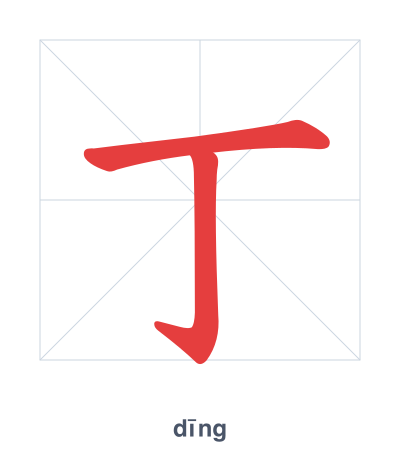
Open Hanzi Writer to see the animated stroke order and practice writing 丁 with real-time feedback.
The character 丁 (dīng) is written with 2 strokes. Follow the standard Chinese stroke order: top to bottom, left to right, outside before inside. The radical 一 is one of its key components.
Practice the correct stroke order with the Hanzi Writer app to see animated stroke-by-stroke guidance with real-time feedback.
丁 means man; small cube (of food); the fourth Heavenly Stem.
As an HSK Level 7 character, 丁 is an intermediate-level character.
Originally a pictograph of a nail or peg, showing a top view of a nail head with a shaft descending. Over time, it came to symbolize a sturdy man (like a 'nail' of a person) and was borrowed for the fourth Heavenly Stem.
💡 Memory Tip: Picture a man with arms stretched out like a T-shape, balancing a small cube of tofu on his head as a hat.
丁香花的味道很好闻。
dīng xiāng huā de wèi dào hěn hǎo wén
Lilacs smell very good.
园丁在花园里工作。
yuán dīng zài huā yuán lǐ gōng zuò
The gardener is working in the garden.
他的裤子上有个补丁。
tā de kù zi shàng yǒu gè bǔ dīng
There is a patch on his pants.
Open Hanzi Writer to see the animated stroke order and practice writing 丁 with real-time feedback.
✨ Animated stroke order · Handwriting recognition · HSK-graded practice · Free to use
丁 is made of just two strokes: a horizontal line (一) and a vertical hook. Originally it was a pictograph of a nail, so it carries the idea of a sturdy object. This led to meanings like 'man' (a strong person) and 'small cube' (like diced food shaped like a nail head).