丂 (kǎo) means "to obstruct; breath struggling to escape (archaic)" in Chinese. It has 2 strokes with the radical 一.
Rated 1.9/5 in difficulty (beginner-friendly).
Appears in 3+ common words including 丂丂 (kǎo kǎo), 丂声 (kǎo shēng), 丂音 (kǎo yīn).
In the Hanzi Writer app, most learners master 丂 within 3 practice attempts using stroke-by-stroke animation.
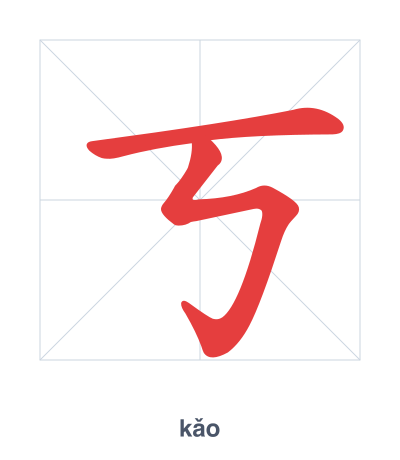
Open Hanzi Writer to see the animated stroke order and practice writing 丂 with real-time feedback.
The character 丂 (kǎo) is written with 2 strokes. Follow the standard Chinese stroke order: top to bottom, left to right, outside before inside. The radical 一 is one of its key components.
Practice the correct stroke order with the Hanzi Writer app to see animated stroke-by-stroke guidance with real-time feedback.
丂 means to obstruct; breath struggling to escape (archaic).
丂 is an archaic pictograph of a curved, bent shape—like a crooked stick or a blocked passage—representing the idea of something obstructing the flow of air, causing breath to struggle and escape with difficulty. In ancient scripts, this simple figure visually mimics the sense of a physical hindrance or blockage.
💡 Memory Tip: Picture a hook-shaped pipe (丂) stuck in your throat, making every breath a struggle to escape.
他发出了丂丂的声音。
tā fā chū le kǎo kǎo de shēng yīn
He made a knocking sound.
我听到了丂声。
wǒ tīng dào le kǎo shēng
I heard a shout.
这是一个奇特的丂音。
zhè shì yí gè qí tè de kǎo yīn
This is a peculiar 'kao' sound.
Open Hanzi Writer to see the animated stroke order and practice writing 丂 with real-time feedback.
✨ Animated stroke order · Handwriting recognition · HSK-graded practice · Free to use
丂 consists of the radical 一 (one, representing a horizontal line) and a curved stroke that resembles breath being blocked. Together, they depict air struggling to escape past an obstruction, which matches the archaic meaning of 'to obstruct' or 'breath struggling to escape'.