丌 (jī) means "table; pedestal (archaic)" in Chinese. It has 3 strokes with the radical 一.
Rated 2.2/5 in difficulty (moderate).
Appears in 3+ common words including 丌部 (jī bù), 丌下 (jī xià), 丌其 (jī qí).
Hanzi Writer's stroke validation shows learners typically need 5-8 attempts to write 丌 with correct proportion and order.
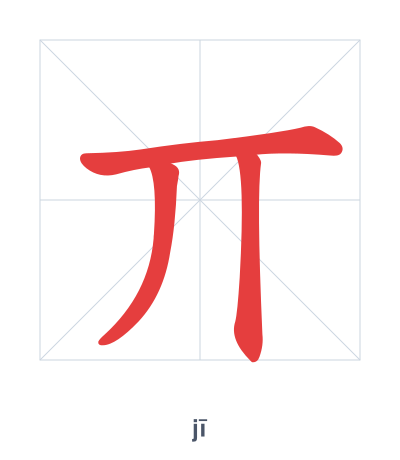
Open Hanzi Writer to see the animated stroke order and practice writing 丌 with real-time feedback.
The character 丌 (jī) is written with 3 strokes. Follow the standard Chinese stroke order: top to bottom, left to right, outside before inside. The radical 一 is one of its key components.
Practice the correct stroke order with the Hanzi Writer app to see animated stroke-by-stroke guidance with real-time feedback.
丌 means table; pedestal (archaic).
This character is a pictograph of a table or pedestal. Its ancient form depicted a flat surface with two supporting legs, resembling a simple stand. The modern shape retains the horizontal top stroke and two diagonal leg strokes.
💡 Memory Tip: Picture a tiny table (the horizontal line) with two slanted legs (the downward strokes) forming a pedestal for a small statue.
丌部是字典里的部首。
jī bù shì zì diǎn lǐ de bù shǒu
The 'Qi' radical is a radical in the dictionary.
丌下是一个古老的词。
jī xià shì yí gè gǔ lǎo de cí
'Qixia' is an ancient word.
丌其的用法非常少见。
jī qí de yòng fǎ fēi cháng shǎo jiàn
The usage of 'Qiqi' is very rare.
Open Hanzi Writer to see the animated stroke order and practice writing 丌 with real-time feedback.
✨ Animated stroke order · Handwriting recognition · HSK-graded practice · Free to use
The character 丌 is made of a horizontal line (一) on top and two downward strokes below, representing a table top and legs. This shape directly shows its archaic meaning of 'table' or 'pedestal'.