跌 (diē) means "to fall; to tumble" in Chinese. It has 12 strokes with the radical 足, and is HSK Level 6.
Rated 4.2/5 in difficulty (advanced).
Harder than 91% of HSK Level 6 characters.
Appears in 3+ common words including 跌倒 (diē dǎo), 跌落 (diē luò), 跌破 (diē pò).
Due to its 12 strokes, Hanzi Writer's error detection shows 跌 requires focused practice — most learners need 10+ attempts for consistent accuracy.
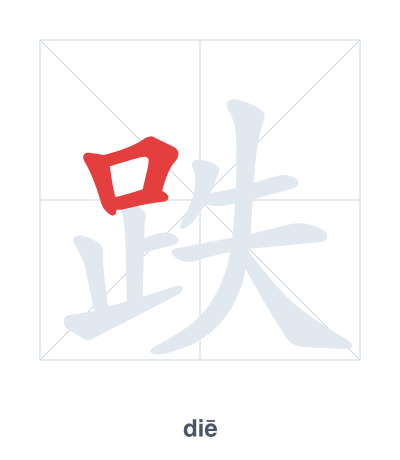
Open Hanzi Writer to see the animated stroke order and practice writing 跌 with real-time feedback.
The character 跌 (diē) is written with 12 strokes. Follow the standard Chinese stroke order: top to bottom, left to right, outside before inside. The radical 足 is one of its key components.
Practice the correct stroke order with the Hanzi Writer app to see animated stroke-by-stroke guidance with real-time feedback.
跌 means to fall; to tumble.
As an HSK Level 6 character, 跌 is an intermediate-level character.
跌 is a phono-semantic compound: the radical 足 (foot) indicates falling involves the feet, while the component 失 (shī, meaning 'to lose') hints at losing balance. Together, they depict the idea of 'foot losing stability,' leading to a tumble or fall.
💡 Memory Tip: Imagine your foot (足) steps on a banana peel and you 'lose' (失) your balance—you fall flat with a loud 'diē'!
他在路上跌倒了。
tā zài lù shàng diē dǎo le
He fell down on the road.
苹果从树上跌落。
píng guǒ cóng shù shàng diē luò
The apple dropped from the tree.
他的膝盖跌破了。
tā de xī gài diē pò le
He scraped his knee.
Open Hanzi Writer to see the animated stroke order and practice writing 跌 with real-time feedback.
✨ Animated stroke order · Handwriting recognition · HSK-graded practice · Free to use
跌 is composed of the radical 足 (foot) on the left and the component 失 (to lose) on the right. The radical 足 indicates the action involves the foot, while 失 suggests losing balance, together meaning "to fall" or "to tumble."