瞪 (dèng) means "to stare; to glare" in Chinese. It has 17 strokes with the radical 目, and is HSK Level 7.
Rated 4.2/5 in difficulty (advanced).
Harder than 74% of HSK Level 7 characters.
Appears in 3+ common words including 瞪眼 (dèng yǎn), 目瞪口呆 (mù dèng kǒu dāi), 瞪着 (dèng zhe).
Due to its 17 strokes, Hanzi Writer's error detection shows 瞪 requires focused practice — most learners need 10+ attempts for consistent accuracy.
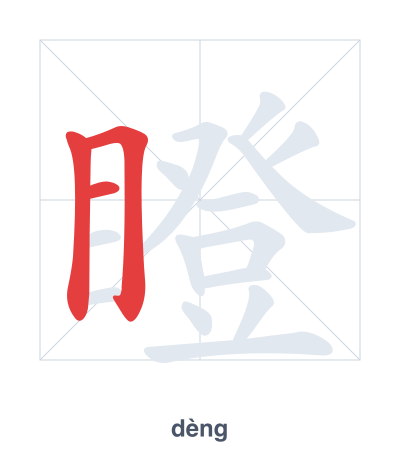
Open Hanzi Writer to see the animated stroke order and practice writing 瞪 with real-time feedback.
The character 瞪 (dèng) is written with 17 strokes. Follow the standard Chinese stroke order: top to bottom, left to right, outside before inside. The radical 目 is one of its key components.
Practice the correct stroke order with the Hanzi Writer app to see animated stroke-by-stroke guidance with real-time feedback.
瞪 means to stare; to glare.
As an HSK Level 7 character, 瞪 is an intermediate-level character.
瞪 combines the eye radical 目 with 登 (meaning 'to ascend' or 'climb'), suggesting eyes that are wide open and bulging upward—like someone staring intensely or glaring. The 登 component also hints at the forceful, almost climbing quality of a hard stare.
💡 Memory Tip: Picture a man climbing a ladder (登) with his eyes (目) so wide and fixed that he glares at the top rung, unable to look away.
他气得直瞪眼。
tā qì dé zhí dèng yǎn
He was so angry that he stared wide-eyed.
他听得目瞪口呆。
tā tīng dé mù dèng kǒu dāi
He was dumbstruck as he listened.
他瞪着大眼睛。
tā dèng zhe dà yǎn jīng
He stared with wide eyes.
Open Hanzi Writer to see the animated stroke order and practice writing 瞪 with real-time feedback.
✨ Animated stroke order · Handwriting recognition · HSK-graded practice · Free to use
瞪 is made of the radical 目 (eye) on the left, and the phonetic component 登 (dēng) on the right. The eye radical directly connects to the meaning of staring or glaring, while 登 hints at the pronunciation (dèng). This combination shows that 瞪 is an action done with the eyes.