呆 (dāi) means "dull; blank; to stay" in Chinese. It has 7 strokes with the radical 口, and is HSK Level 5.
Rated 3.5/5 in difficulty (challenging).
Harder than 22% of HSK Level 5 characters.
Appears in 3+ common words including 发呆 (fā dāi), 呆子 (dāi zi), 吓呆 (xià dāi).
Due to its 7 strokes, Hanzi Writer's error detection shows 呆 requires focused practice — most learners need 10+ attempts for consistent accuracy.
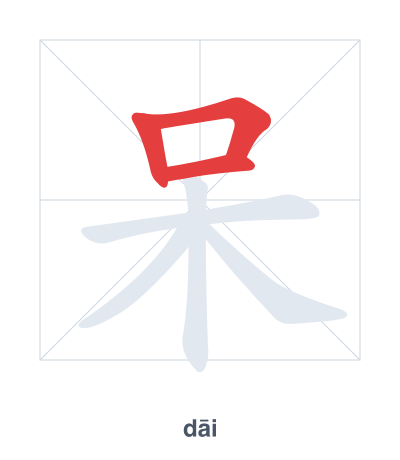
Open Hanzi Writer to see the animated stroke order and practice writing 呆 with real-time feedback.
The character 呆 (dāi) is written with 7 strokes. Follow the standard Chinese stroke order: top to bottom, left to right, outside before inside. The radical 口 is one of its key components.
Practice the correct stroke order with the Hanzi Writer app to see animated stroke-by-stroke guidance with real-time feedback.
呆 means dull; blank; to stay.
As an HSK Level 5 character, 呆 is an intermediate-level character.
呆 combines 口 (mouth) and 木 (tree), suggesting a mouth as unresponsive as wood, conveying dullness or blankness. It also means 'to stay' as in remaining still like a wooden object.
💡 Memory Tip: Picture a person with a wooden (木) mouth (口), staring blankly — that's the dull look of 呆.
你为什么在发呆?
nǐ wèi shén me zài fā dāi
Why are you staring blankly?
他真是个书呆子。
tā zhēn shì gè shū dāi zi
He is such a nerd.
那个消息让他吓呆了。
nà ge xiāo xī ràng tā xià dāi le
That news stunned him.
Open Hanzi Writer to see the animated stroke order and practice writing 呆 with real-time feedback.
✨ Animated stroke order · Handwriting recognition · HSK-graded practice · Free to use
呆 is made of the radical 口 (mouth) on top and the component 木 (tree) underneath. The mouth represents a person's face or expression, and the tree suggests something stiff and unmoving, together conveying a blank or dull look.