喘 (chuǎn) means "to pant / to gasp" in Chinese. It has 12 strokes with the radical 口, and is HSK Level 7.
Rated 4.2/5 in difficulty (advanced).
Harder than 49% of HSK Level 7 characters.
Appears in 3+ common words including 喘气 (chuǎn qì), 喘息 (chuǎn xī), 哮喘 (xiāo chuǎn).
Due to its 12 strokes, Hanzi Writer's error detection shows 喘 requires focused practice — most learners need 10+ attempts for consistent accuracy.
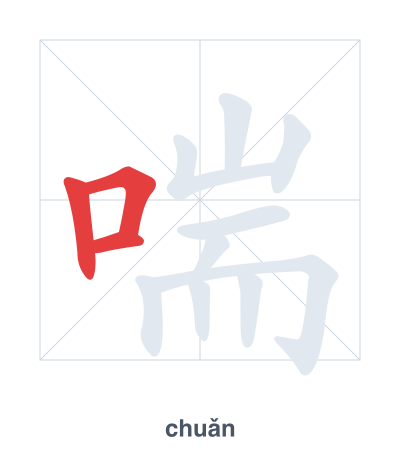
Open Hanzi Writer to see the animated stroke order and practice writing 喘 with real-time feedback.
The character 喘 (chuǎn) is written with 12 strokes. Follow the standard Chinese stroke order: top to bottom, left to right, outside before inside. The radical 口 is one of its key components.
Practice the correct stroke order with the Hanzi Writer app to see animated stroke-by-stroke guidance with real-time feedback.
喘 means to pant / to gasp.
As an HSK Level 7 character, 喘 is an intermediate-level character.
喘 combines the mouth radical 口 (indicating breathing) with the phonetic component 耑 (chuǎn), which originally depicted a plant sprouting but here suggests rapid, repeated motion—like the short gasps of panting.
💡 Memory Tip: Picture a mouth (口) panting heavily beside a mountain (山, top of 耑), as if you've just climbed it and can barely catch your breath.
他累得直喘气。
tā lèi dé zhí chuǎn qì
He was so tired that he was gasping for breath.
让他喘息一会儿。
ràng tā chuǎn xī yī huì er
Let him catch his breath for a moment.
他患有哮喘病。
tā huàn yǒu xiāo chuǎn bìng
He suffers from asthma.
Open Hanzi Writer to see the animated stroke order and practice writing 喘 with real-time feedback.
✨ Animated stroke order · Handwriting recognition · HSK-graded practice · Free to use
The character 喘 combines the radical 口 (mouth) on the left and the phonetic component 耑 (duān) on the right. The mouth radical hints at the action of breathing or speaking, while 耑 provides the sound chuǎn. Together, they form a character that means "to pant" or "to gasp" — a breathy action involving the mouth.