哮 (xiāo) means "To roar / To wheeze" in Chinese. It has 10 strokes with the radical 口.
Rated 4.2/5 in difficulty (advanced).
Appears in 3+ common words including 哮喘 (xiāo chuǎn), 咆哮 (páo xiāo), 哮 (xiāo).
Due to its 10 strokes, Hanzi Writer's error detection shows 哮 requires focused practice — most learners need 10+ attempts for consistent accuracy.
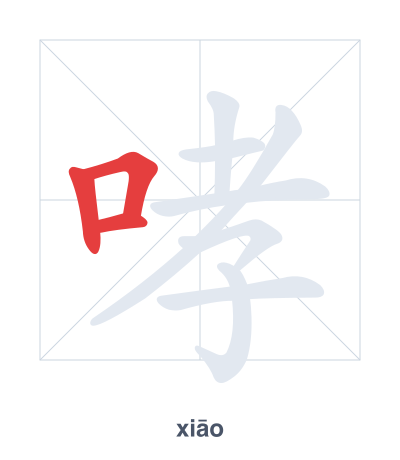
Open Hanzi Writer to see the animated stroke order and practice writing 哮 with real-time feedback.
The character 哮 (xiāo) is written with 10 strokes. Follow the standard Chinese stroke order: top to bottom, left to right, outside before inside. The radical 口 is one of its key components.
Practice the correct stroke order with the Hanzi Writer app to see animated stroke-by-stroke guidance with real-time feedback.
哮 means To roar / To wheeze.
The character 哮 combines the mouth radical (口) with the phonetic component 孝 (xiào). It originally represented the sound of a wild beast's roar or a person's wheezing breath, using 口 to indicate the action of the mouth and 孝 to approximate the sound.
💡 Memory Tip: Picture an old person (耂) and a child (子) both roaring into your mouth (口), making you wheeze from the noise.
他有哮喘病。
tā yǒu xiāo chuǎn bìng
He has asthma.
大海在咆哮。
dà hǎi zài páo xiāo
The sea is roaring.
狂风在咆哮。
kuáng fēng zài páo xiāo
The gale is roaring.
Open Hanzi Writer to see the animated stroke order and practice writing 哮 with real-time feedback.
✨ Animated stroke order · Handwriting recognition · HSK-graded practice · Free to use
The character 哮 is composed of the radical 口 (mouth) on the left and the component 孝 (xiào, filial piety) on the right. The mouth radical directly connects to the meaning of roaring or wheezing, as these are sounds produced by the mouth. The right part 孝 primarily provides the pronunciation hint xiào (though 哮 reads xiāo) and does not contribute to the meaning.