毙 (bì) means "To die; to kill" in Chinese. It has 10 strokes with the radical 比, and is HSK Level 7.
Rated 4.2/5 in difficulty (advanced).
Harder than 65% of HSK Level 7 characters.
Appears in 3+ common words including 枪毙 (qiāng bì), 毙命 (bì mìng), 击毙 (jī bì).
Due to its 10 strokes, Hanzi Writer's error detection shows 毙 requires focused practice — most learners need 10+ attempts for consistent accuracy.
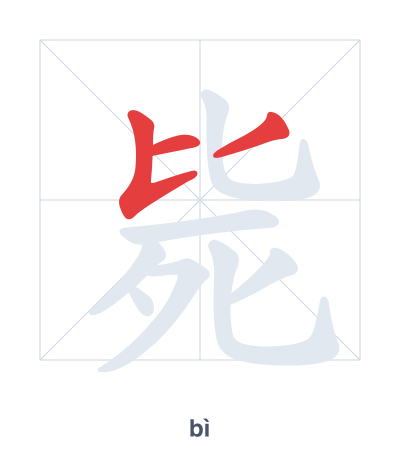
Open Hanzi Writer to see the animated stroke order and practice writing 毙 with real-time feedback.
The character 毙 (bì) is written with 10 strokes. Follow the standard Chinese stroke order: top to bottom, left to right, outside before inside. The radical 比 is one of its key components.
Practice the correct stroke order with the Hanzi Writer app to see animated stroke-by-stroke guidance with real-time feedback.
毙 means To die; to kill.
As an HSK Level 7 character, 毙 is an intermediate-level character.
The character 毙 combines the phonetic component 比 (bì, meaning 'compare') and the semantic component 死 (sǐ, meaning 'death'), indicating the concept of dying or being killed; the bottom part 死 directly shows death, while the top 比 provides pronunciation.
💡 Memory Tip: Picture two people (比) comparing who dies first (死) in a dramatic showdown.
罪犯被处以枪毙。
zuì fàn bèi chǔ yǐ qiāng bì
The criminal was sentenced to death by firing squad.
坏人当场毙命。
huài rén dāng chǎng bì mìng
The villain was killed on the spot.
歹徒被警察击毙。
dǎi tú bèi jǐng chá jī bì
The criminal was shot dead by the police.
Open Hanzi Writer to see the animated stroke order and practice writing 毙 with real-time feedback.
✨ Animated stroke order · Handwriting recognition · HSK-graded practice · Free to use
毙 is made of two parts: the left side is 比 (bǐ, to compare) and the right side is 歹 (dǎi, meaning bad or death). The combination suggests something bad that leads to death, which matches the meaning "to die" or "to kill."