毖 (bì) means "To caution; to guard against" in Chinese. It has 9 strokes with the radical 比.
Rated 4/5 in difficulty (challenging).
Appears in 3+ common words including 惩前毖后 (chéng qián bì hòu), 毖慎 (bì shèn), 毖涌 (bì yǒng).
Due to its 9 strokes, Hanzi Writer's error detection shows 毖 requires focused practice — most learners need 10+ attempts for consistent accuracy.
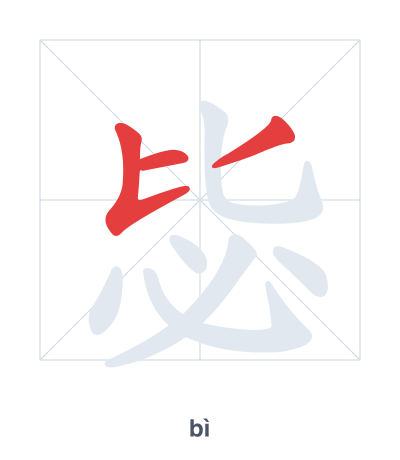
Open Hanzi Writer to see the animated stroke order and practice writing 毖 with real-time feedback.
The character 毖 (bì) is written with 9 strokes. Follow the standard Chinese stroke order: top to bottom, left to right, outside before inside. The radical 比 is one of its key components.
Practice the correct stroke order with the Hanzi Writer app to see animated stroke-by-stroke guidance with real-time feedback.
毖 means To caution; to guard against.
| Character | 毖 |
| Pinyin | bì (bi) |
| Meaning | To caution; to guard against |
| Strokes | 9 |
| Radical | 比 |
| Difficulty | 4/5 |
毖 combines the radical 比 (compare) with 必 (must) as a phonetic component. The radical suggests the idea of carefully comparing or checking, which connects to the meaning of caution and guarding against errors.
💡 Memory Tip: Picture two people (比) comparing notes while one says '必 (must) double-check!' to guard against any mistake.
我们要惩前毖后。
wǒ men yào chéng qián bì hòu
We should learn from the past to avoid future mistakes.
凡事都要毖慎。
fán shì dōu yào bì shèn
One should be cautious and prudent in everything.
泉水毖涌而出。
quán shuǐ bì yǒng ér chū
The spring water gushes out.
Open Hanzi Writer to see the animated stroke order and practice writing 毖 with real-time feedback.
✨ Animated stroke order · Handwriting recognition · HSK-graded practice · Free to use
The character 毖 is made of 比 (compare) on top and 必 (must) below. The top part suggests comparing or pairing, while the bottom indicates necessity, together implying the need to compare past actions to guard against future errors. This structure directly reflects the meaning of caution and prevention.