毗 (pí) means "Adjacent; to border" in Chinese. It has 9 strokes with the radical 比.
Rated 4/5 in difficulty (challenging).
Appears in 3+ common words including 毗邻 (pí lín), 毗连 (pí lián), 毗助 (pí zhù).
Due to its 9 strokes, Hanzi Writer's error detection shows 毗 requires focused practice — most learners need 10+ attempts for consistent accuracy.
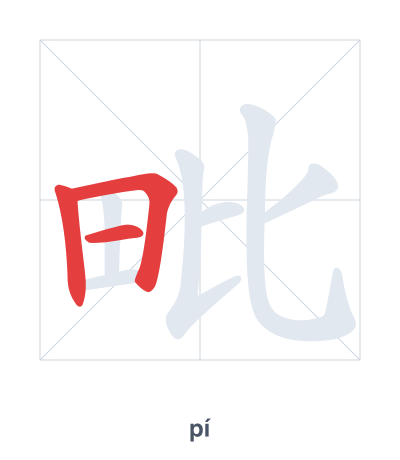
Open Hanzi Writer to see the animated stroke order and practice writing 毗 with real-time feedback.
The character 毗 (pí) is written with 9 strokes. Follow the standard Chinese stroke order: top to bottom, left to right, outside before inside. The radical 比 is one of its key components.
Practice the correct stroke order with the Hanzi Writer app to see animated stroke-by-stroke guidance with real-time feedback.
毗 means Adjacent; to border.
| Character | 毗 |
| Pinyin | pí (pi) |
| Meaning | Adjacent; to border |
| Strokes | 9 |
| Radical | 比 |
| Difficulty | 4/5 |
The character 毗 combines 比 (two persons side by side) with 田 (field), suggesting fields that are adjacent to each other. This structure visually represents the idea of neighboring or bordering land.
💡 Memory Tip: Picture two people (比) standing shoulder to shoulder at the edge of a field (田), showing they are adjacent.
我家与公园毗邻。
wǒ jiā yǔ gōng yuán pí lín
My house is next to the park.
这里的房屋相毗连。
zhè lǐ de fáng wū xiāng pí lián
The houses here are adjacent to each other.
感谢你的毗助。
gǎn xiè nǐ de pí zhù
Thank you for your assistance.
Open Hanzi Writer to see the animated stroke order and practice writing 毗 with real-time feedback.
✨ Animated stroke order · Handwriting recognition · HSK-graded practice · Free to use
毗 is made of 田 (field) on the left and 比 (compare) on the right. The field component suggests land, while 比 implies comparison or proximity. Together they convey the idea of fields that are next to each other, hence 'adjacent' or 'bordering'.