惫 (bèi) means "exhausted; tired" in Chinese. It has 12 strokes with the radical 心, and is HSK Level 7.
Rated 4.2/5 in difficulty (advanced).
Harder than 56% of HSK Level 7 characters.
Appears in 3+ common words including 疲惫 (pí bèi), 惫色 (bèi sè), 惫累 (bèi lèi).
Due to its 12 strokes, Hanzi Writer's error detection shows 惫 requires focused practice — most learners need 10+ attempts for consistent accuracy.
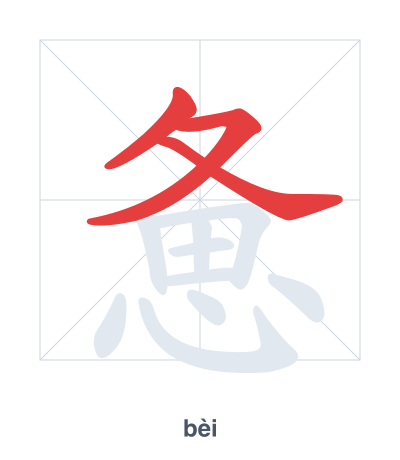
Open Hanzi Writer to see the animated stroke order and practice writing 惫 with real-time feedback.
The character 惫 (bèi) is written with 12 strokes. Follow the standard Chinese stroke order: top to bottom, left to right, outside before inside. The radical 心 is one of its key components.
Practice the correct stroke order with the Hanzi Writer app to see animated stroke-by-stroke guidance with real-time feedback.
惫 means exhausted; tired.
As an HSK Level 7 character, 惫 is an intermediate-level character.
The character 惫 combines 'heart' (心) indicating a mental or emotional state, and 'prepare' (备) as a phonetic component. The idea is that being fully prepared or burdened with tasks drains the heart, leading to exhaustion.
💡 Memory Tip: Picture a farmer (备: 夂 like a bent person over 田 field) whose heart (心) is so weary from endless work that he collapses in exhaustion.
他感到非常疲惫。
tā gǎn dào fēi cháng pí bèi
He feels very exhausted.
他脸上满是惫色。
tā liǎn shàng mǎn shì bèi sè
His face was full of exhaustion.
工作让他很惫累。
gōng zuò ràng tā hěn bèi lèi
Work makes him very tired.
Open Hanzi Writer to see the animated stroke order and practice writing 惫 with real-time feedback.
✨ Animated stroke order · Handwriting recognition · HSK-graded practice · Free to use
惫 has two parts: the top part 备 (bèi, "to prepare") gives a phonetic hint, and the bottom radical 心 (xīn, "heart") indicates the meaning relates to a feeling or emotion. Together, the idea is that preparing too much exhausts your heart, so it means "exhausted" or "tired."