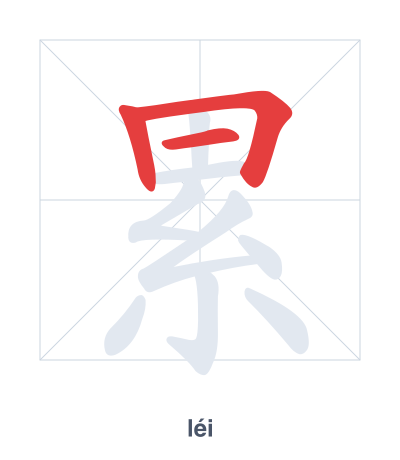
累 (léi) means "tired, fatigued" in Chinese. It has 11 strokes with the radical 糸, and is HSK Level 1. Difficulty: 3.7/5.
tired, fatigued
The character 累 (léi) is written with 11 strokes. Follow the standard Chinese stroke order: top to bottom, left to right, outside before inside. The radical 糸 is one of its key components.
Practice the correct stroke order with the Hanzi Writer app to see animated stroke-by-stroke guidance with real-time feedback.
累 is pronounced léi in Mandarin Chinese. It means tired, fatigued.
This is a polyphonic character with readings: léi, lěi, lèi.
As an HSK Level 1 character, 累 is among the first characters beginners learn.
连续加班让他感到非常劳累。
lián xù jiā bān ràng tā gǎn dào fēi cháng láo lèi
Continuous overtime work has made him feel very tired.
经过一整天的长途跋涉,大家都感到非常疲累。
jīng guò yī zhěng tiān de cháng tú bá shè , dà jiā dōu gǎn dào fēi cháng pí lèi 。
After a long day of trekking, everyone felt very exhausted.
通过多年的工作,他积累了丰富的管理经验。
tōng guò duō nián de gōng zuò , tā jī lěi le fēng fù de guǎn lǐ jīng yàn 。
Through years of work, he has accumulated rich management experience.
他的个人错误连累了整个团队的进度。
tā de gè rén cuò wù lián lěi le zhěng gè tuán duì de jìn dù
His personal mistake delayed the progress of the entire team.
Open Hanzi Writer to see the animated stroke order and practice writing 累 with real-time feedback.