访 (fǎng) means "To visit / To seek" in Chinese. It has 6 strokes with the radical 讠, and is HSK Level 3.
Rated 2.9/5 in difficulty (moderate).
Harder than 26% of HSK Level 3 characters.
Appears in 3+ common words including 访问 (fǎng wèn), 采访 (cǎi fǎng), 拜访 (bài fǎng).
Hanzi Writer's stroke validation shows learners typically need 5-8 attempts to write 访 with correct proportion and order.
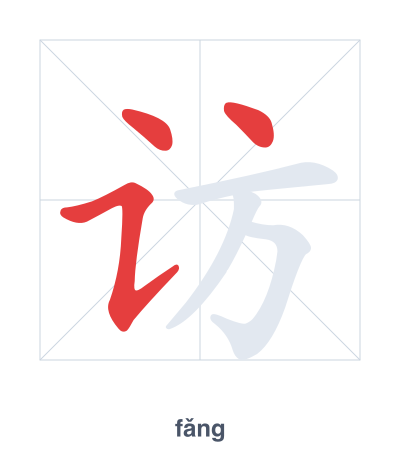
Open Hanzi Writer to see the animated stroke order and practice writing 访 with real-time feedback.
The character 访 (fǎng) is written with 6 strokes. Follow the standard Chinese stroke order: top to bottom, left to right, outside before inside. The radical 讠 is one of its key components.
Practice the correct stroke order with the Hanzi Writer app to see animated stroke-by-stroke guidance with real-time feedback.
访 means To visit / To seek.
As an HSK Level 3 character, 访 is an intermediate-level character.
访 combines the speech radical 讠, indicating spoken communication, with 方 (direction/place), suggesting speaking to ask directions or to seek someone. In ancient Chinese, visiting often involved verbal inquiry about where someone was, so the character visually represents 'speaking to find a place or person.'
💡 Memory Tip: Picture a traveler saying 'fang' (方) to ask a local for directions, visiting a new place through speech.
他去访问中国了。
tā qù fǎng wèn zhōng guó le
He went to visit China.
记者在采访他。
jì zhě zài cǎi fǎng tā
The reporter is interviewing him.
我明天去拜访你。
wǒ míng tiān qù bài fǎng nǐ
I'll visit you tomorrow.
Open Hanzi Writer to see the animated stroke order and practice writing 访 with real-time feedback.
✨ Animated stroke order · Handwriting recognition · HSK-graded practice · Free to use
访 combines the speech radical 讠 (yán, meaning words or speech) on the left with the character 方 (fāng, meaning direction or square) on the right. The speech radical hints at using language to visit or seek someone, while 方 gives the pronunciation and suggests the idea of going in a direction to meet someone.