纸 (zhǐ) means "paper" in Chinese. It has 7 strokes with the radical 纟, and is HSK Level 2.
Rated 2.9/5 in difficulty (moderate).
Harder than 40% of HSK Level 2 characters.
Appears in 3+ common words including 报纸 (bào zhǐ), 纸巾 (zhǐ jīn), 白纸 (bái zhǐ).
Hanzi Writer's stroke validation shows learners typically need 5-8 attempts to write 纸 with correct proportion and order.
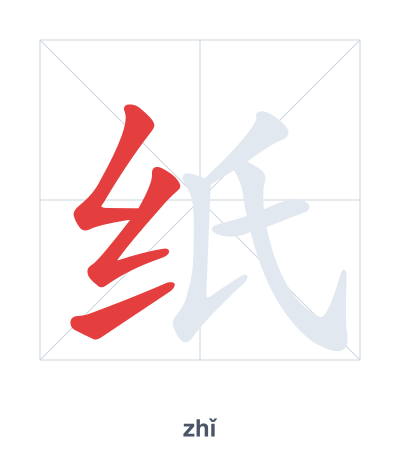
Open Hanzi Writer to see the animated stroke order and practice writing 纸 with real-time feedback.
The character 纸 (zhǐ) is written with 7 strokes. Follow the standard Chinese stroke order: top to bottom, left to right, outside before inside. The radical 纟 is one of its key components.
Practice the correct stroke order with the Hanzi Writer app to see animated stroke-by-stroke guidance with real-time feedback.
纸 means paper.
As an HSK Level 2 character, 纸 is among the first characters beginners learn.
纸 is a phono-semantic compound: the left side 纟 (silk) indicates that early paper was made from silk fibers, while the right side 氏 originally provided the pronunciation (similar to zhǐ). The character visually connects to paper's historical production from silk or fibrous materials.
💡 Memory Tip: Imagine a silk thread (纟) binding a folded sheet of paper (the shape of 氏) to keep it neat.
爸爸在看报纸。
bà bà zài kàn bào zhǐ
Dad is reading the newspaper.
请给我一张纸巾。
qǐng gěi wǒ yī zhāng zhǐ jīn
Please give me a tissue.
这是一张白纸。
zhè shì yī zhāng bái zhǐ
This is a piece of white paper.
Open Hanzi Writer to see the animated stroke order and practice writing 纸 with real-time feedback.
✨ Animated stroke order · Handwriting recognition · HSK-graded practice · Free to use
The left side 纟 is the radical for silk or thread, which hints at paper's fibrous origin. The right side 氏 provides a clue to pronunciation, and together they form the character for paper.