饱 (bǎo) means "full (after eating)" in Chinese. It has 8 strokes with the radical 饣, and is HSK Level 2.
Rated 3.2/5 in difficulty (challenging).
Harder than 55% of HSK Level 2 characters.
Appears in 3+ common words including 吃饱 (chī bǎo), 饱满 (bǎo mǎn), 饱含 (bǎo hán).
Due to its 8 strokes, Hanzi Writer's error detection shows 饱 requires focused practice — most learners need 10+ attempts for consistent accuracy.
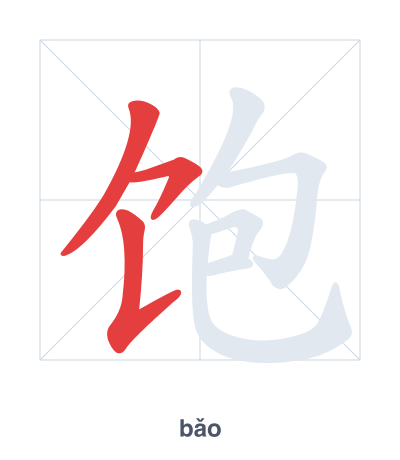
Open Hanzi Writer to see the animated stroke order and practice writing 饱 with real-time feedback.
The character 饱 (bǎo) is written with 8 strokes. Follow the standard Chinese stroke order: top to bottom, left to right, outside before inside. The radical 饣 is one of its key components.
Practice the correct stroke order with the Hanzi Writer app to see animated stroke-by-stroke guidance with real-time feedback.
饱 means full (after eating).
As an HSK Level 2 character, 饱 is among the first characters beginners learn.
The character 饱 combines the food radical 饣 (a simplified form of 食) with 包 (bāo, meaning 'wrap' or 'envelop'). The idea is that after eating, one's stomach is 'wrapped' or filled with food, leading to a feeling of fullness. This compound structure visually captures the concept of being satiated.
💡 Memory Tip: Imagine your stomach as a bag (包) that is so stuffed with food (饣) it's completely full (饱).
我已经吃饱了。
wǒ yǐ jīng chī bǎo le
I am already full.
他的精神很饱满。
tā de jīng shén hěn bǎo mǎn
He is full of energy.
他的眼里饱含泪水。
tā de yǎn lǐ bǎo hán lèi shuǐ
His eyes are filled with tears.
Open Hanzi Writer to see the animated stroke order and practice writing 饱 with real-time feedback.
✨ Animated stroke order · Handwriting recognition · HSK-graded practice · Free to use
饱 is composed of the food radical 饣 on the left and the phonetic component 包 on the right. The radical signals it relates to eating, while 包 (which means 'wrap') suggests the idea of being filled up or wrapped with food.