罪 (zuì) means "Crime; sin; guilt" in Chinese. It has 13 strokes with the radical 罒, and is HSK Level 6.
Rated 4.2/5 in difficulty (advanced).
Harder than 85% of HSK Level 6 characters.
Appears in 3+ common words including 犯罪 (fàn zuì), 罪名 (zuì míng), 受罪 (shòu zuì).
Due to its 13 strokes, Hanzi Writer's error detection shows 罪 requires focused practice — most learners need 10+ attempts for consistent accuracy.
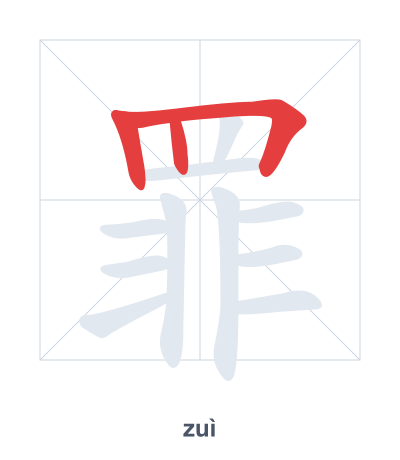
Open Hanzi Writer to see the animated stroke order and practice writing 罪 with real-time feedback.
The character 罪 (zuì) is written with 13 strokes. Follow the standard Chinese stroke order: top to bottom, left to right, outside before inside. The radical 罒 is one of its key components.
Practice the correct stroke order with the Hanzi Writer app to see animated stroke-by-stroke guidance with real-time feedback.
罪 means Crime; sin; guilt.
As an HSK Level 6 character, 罪 is an intermediate-level character.
罪 combines 罒 (a net, originally representing a snare or trap) and 非 (meaning 'wrong' or 'against'). Together, they depict a 'net of wrongdoing'—a trap for those who commit unlawful acts, hence crime or guilt. The character suggests being caught in the consequences of one's misdeeds.
💡 Memory Tip: Imagine a criminal tangled in a net (罒) because they did something wrong (非), caught red-handed in their own guilt.
犯罪是不对的。
fàn zuì shì bú duì de
Committing a crime is wrong.
他的罪名成立了。
tā de zuì míng chéng lì le
He was found guilty.
坐长途车真受罪。
zuò cháng tú chē zhēn shòu zuì
Taking a long-distance bus is a real ordeal.
Open Hanzi Writer to see the animated stroke order and practice writing 罪 with real-time feedback.
✨ Animated stroke order · Handwriting recognition · HSK-graded practice · Free to use
罪 is made of the radical 罒 (net) on top and 非 (wrong/negative) below. The net suggests capturing or covering, while 非 indicates something bad, so together they represent capturing wrongdoing, which relates to crime or sin.