拿 (ná) means "to take; to hold" in Chinese. It has 10 strokes with the radical 手, and is HSK Level 1.
Rated 3.7/5 in difficulty (challenging).
Harder than 87% of HSK Level 1 characters.
Appears in 3+ common words including 拿着 (ná zhe), 拿走 (ná zǒu), 拿手 (ná shǒu).
Due to its 10 strokes, Hanzi Writer's error detection shows 拿 requires focused practice — most learners need 10+ attempts for consistent accuracy.
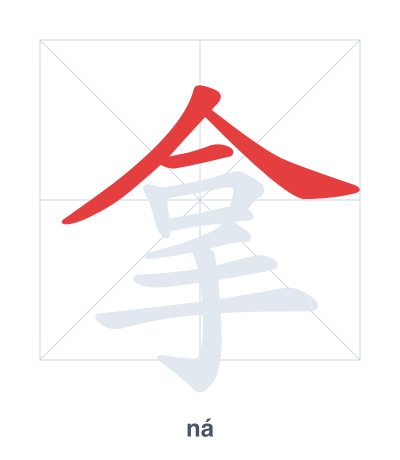
Open Hanzi Writer to see the animated stroke order and practice writing 拿 with real-time feedback.
The character 拿 (ná) is written with 10 strokes. Follow the standard Chinese stroke order: top to bottom, left to right, outside before inside. The radical 手 is one of its key components.
Practice the correct stroke order with the Hanzi Writer app to see animated stroke-by-stroke guidance with real-time feedback.
拿 means to take; to hold.
As an HSK Level 1 character, 拿 is among the first characters beginners learn.
拿 combines 合 (to bring together) above 手 (hand), suggesting the action of bringing one's hand together to grasp or hold something.
💡 Memory Tip: Picture a hand (手) closing over a mouth (合) to 'take' a bite of food.
他手里拿着花。
tā shǒu lǐ ná zhe huā
He is holding a flower in his hand.
谁拿走了我的书?
shuí ná zǒu le wǒ de shū
Who took my book?
这是我的拿手菜。
zhè shì wǒ de ná shǒu cài
This is my signature dish.
Open Hanzi Writer to see the animated stroke order and practice writing 拿 with real-time feedback.
✨ Animated stroke order · Handwriting recognition · HSK-graded practice · Free to use
拿 is made of two parts: 合 on top, meaning 'to combine' or 'to close', and 手 at the bottom, meaning 'hand'. Together they suggest the action of closing your hand around something to take or hold it.