掣 (chè) means "to pull / to draw" in Chinese. It has 12 strokes with the radical 手.
Rated 4.2/5 in difficulty (advanced).
Appears in 3+ common words including 风驰电掣 (fēng chí diàn chè), 掣肘 (chè zhǒu), 掣动 (chè dòng).
Due to its 12 strokes, Hanzi Writer's error detection shows 掣 requires focused practice — most learners need 10+ attempts for consistent accuracy.
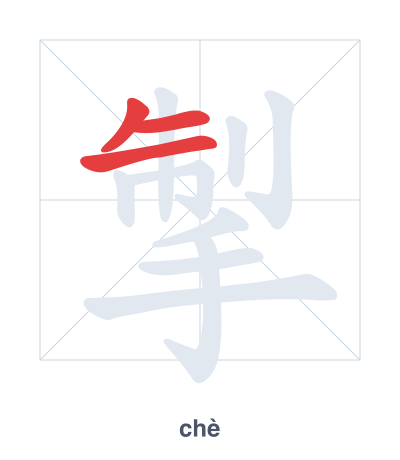
Open Hanzi Writer to see the animated stroke order and practice writing 掣 with real-time feedback.
The character 掣 (chè) is written with 12 strokes. Follow the standard Chinese stroke order: top to bottom, left to right, outside before inside. The radical 手 is one of its key components.
Practice the correct stroke order with the Hanzi Writer app to see animated stroke-by-stroke guidance with real-time feedback.
掣 means to pull / to draw.
| Character | 掣 |
| Pinyin | chè (che) |
| Meaning | to pull / to draw |
| Strokes | 12 |
| Radical | 手 |
| Difficulty | 4.2/5 |
掣 combines the hand radical 手 with 制, which means 'to control' or 'to make'. Together, the character depicts a hand exerting force to pull or draw something under control, emphasizing the action of tugging.
💡 Memory Tip: Picture a hand (手) yanking a control lever (制) to pull a heavy load.
火车风驰电掣般开过。
huǒ chē fēng chí diàn chè bān kāi guò
The train sped past like a flash of lightning.
他的计划受到了掣肘。
tā de jì huà shòu dào le chè zhǒu
His plan was hindered by others.
司机紧急掣动。
sī jī jǐn jí chè dòng
The driver braked urgently.
Open Hanzi Writer to see the animated stroke order and practice writing 掣 with real-time feedback.
✨ Animated stroke order · Handwriting recognition · HSK-graded practice · Free to use
掣 is composed of two parts: 制 (to control) on top and 手 (hand) below. This combination suggests using the hand to control or pull something, which matches the meaning 'to pull' or 'to draw'.