掰 (bāi) means "to break off with hands; to pull apart" in Chinese. It has 12 strokes with the radical 手, and is HSK Level 7.
Rated 4.2/5 in difficulty (advanced).
Harder than 59% of HSK Level 7 characters.
Appears in 3+ common words including 掰开 (bāi kāi), 掰玉米 (bāi yù mǐ), 掰手腕 (bāi shǒu wàn).
Due to its 12 strokes, Hanzi Writer's error detection shows 掰 requires focused practice — most learners need 10+ attempts for consistent accuracy.
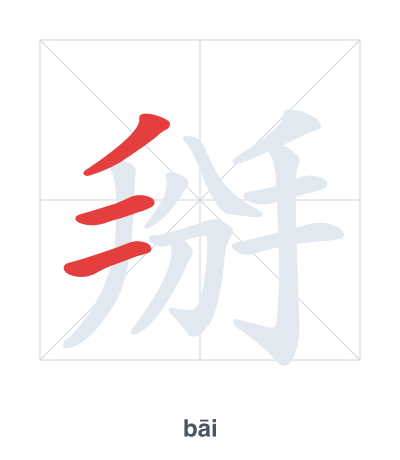
Open Hanzi Writer to see the animated stroke order and practice writing 掰 with real-time feedback.
The character 掰 (bāi) is written with 12 strokes. Follow the standard Chinese stroke order: top to bottom, left to right, outside before inside. The radical 手 is one of its key components.
Practice the correct stroke order with the Hanzi Writer app to see animated stroke-by-stroke guidance with real-time feedback.
掰 means to break off with hands; to pull apart.
As an HSK Level 7 character, 掰 is an intermediate-level character.
掰 combines two 手 (hand) radicals flanking a central 分 (divide), literally meaning 'two hands dividing something' — the image is of hands prying or breaking an object apart.
💡 Memory Tip: Picture two hands (two 手) on either side of a crack (分) forcefully snapping a thick twig in half.
把面包掰开吃。
bǎ miàn bāo bāi kāi chī
Break the bread apart to eat.
我们去掰玉米。
wǒ men qù bāi yù mǐ
Let's go pick corn.
他们在掰手腕。
tā men zài bāi shǒu wàn
They are arm wrestling.
Open Hanzi Writer to see the animated stroke order and practice writing 掰 with real-time feedback.
✨ Animated stroke order · Handwriting recognition · HSK-graded practice · Free to use
掰 is made of three parts: the left radical 扌 (hand), the top right part 分 (meaning to divide), and the bottom right part 手 (another hand). Together, they show two hands pulling something apart to divide it. This reflects the meaning of breaking or pulling something open with your hands.