拳 (quán) means "fist" in Chinese. It has 10 strokes with the radical 手, and is HSK Level 7.
Rated 4.2/5 in difficulty (advanced).
Harder than 57% of HSK Level 7 characters.
Appears in 3+ common words including 拳头 (quán tou), 太极拳 (tài jí quán), 拳击 (quán jī).
Due to its 10 strokes, Hanzi Writer's error detection shows 拳 requires focused practice — most learners need 10+ attempts for consistent accuracy.
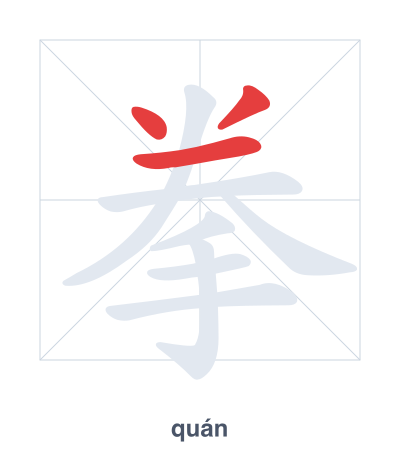
Open Hanzi Writer to see the animated stroke order and practice writing 拳 with real-time feedback.
The character 拳 (quán) is written with 10 strokes. Follow the standard Chinese stroke order: top to bottom, left to right, outside before inside. The radical 手 is one of its key components.
Practice the correct stroke order with the Hanzi Writer app to see animated stroke-by-stroke guidance with real-time feedback.
拳 means fist.
As an HSK Level 7 character, 拳 is an intermediate-level character.
The character 拳 combines the radical 手 (hand) on top with the component 龹 below, which originally meant 'to coil' or 'curl'. Together, they depict a hand curling into a tight fist, ready to strike.
💡 Memory Tip: Imagine your hand (手) coiling into a fist like a coiled spring (龹) about to unleash a punch.
他握紧了拳头。
tā wò jǐn le quán tou
He clenched his fists.
我每天练太极拳。
wǒ měi tiān liàn tài jí quán
I practice Tai Chi every day.
他喜欢看拳击比赛。
tā xǐ huān kàn quán jī bǐ sài
He likes watching boxing matches.
Open Hanzi Writer to see the animated stroke order and practice writing 拳 with real-time feedback.
✨ Animated stroke order · Handwriting recognition · HSK-graded practice · Free to use
The character 拳 combines 手 (shǒu, hand) at the top with 夻 (a variant of 䏍, related to gathering or curling). Together, they show a hand curled into a fist, directly representing the meaning of "fist."