愚 (yú) means "foolish / stupid" in Chinese. It has 13 strokes with the radical 心, and is HSK Level 7.
Rated 4.2/5 in difficulty (advanced).
Harder than 56% of HSK Level 7 characters.
Appears in 3+ common words including 愚蠢 (yú chǔn), 愚人节 (yú rén jié), 愚昧 (yú mèi).
Due to its 13 strokes, Hanzi Writer's error detection shows 愚 requires focused practice — most learners need 10+ attempts for consistent accuracy.
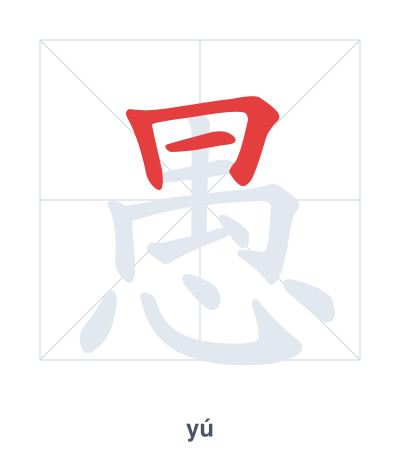
Open Hanzi Writer to see the animated stroke order and practice writing 愚 with real-time feedback.
The character 愚 (yú) is written with 13 strokes. Follow the standard Chinese stroke order: top to bottom, left to right, outside before inside. The radical 心 is one of its key components.
Practice the correct stroke order with the Hanzi Writer app to see animated stroke-by-stroke guidance with real-time feedback.
愚 means foolish / stupid.
As an HSK Level 7 character, 愚 is an intermediate-level character.
愚 combines 禺 (a mythical monkey-like creature) with 心 (heart/mind), suggesting a mind as dull or irrational as a beast. The creature symbolizes foolishness, while 心 points to the mental aspect.
💡 Memory Tip: Picture a monkey (禺) wearing a heart-shaped badge (心) and tripping over its own tail—pure foolishness.
这是一个愚蠢的错误。
zhè shì yí gè yú chǔn de cuò wù
This is a stupid mistake.
明天是愚人节。
míng tiān shì yú rén jié
Tomorrow is April Fool's Day.
我们要告别愚昧。
wǒ men yào gào bié yú mèi
We should bid farewell to ignorance.
Open Hanzi Writer to see the animated stroke order and practice writing 愚 with real-time feedback.
✨ Animated stroke order · Handwriting recognition · HSK-graded practice · Free to use
愚 is composed of two parts: the top part 禺 (yú, an ancient region) and the bottom part 心 (xīn, heart/mind). The heart radical suggests that foolishness is a state of mind, while the phonetic component 禺 hints at the pronunciation. Together, they create the idea of a mind that is slow or dull.