蠢 (chǔn) means "Stupid / Clumsy" in Chinese. It has 21 strokes with the radical 虫, and is HSK Level 7.
Rated 4.2/5 in difficulty (advanced).
Harder than 89% of HSK Level 7 characters.
Appears in 3+ common words including 蠢事 (chǔn shì), 愚蠢 (yú chǔn), 蠢动 (chǔn dòng).
Due to its 21 strokes, Hanzi Writer's error detection shows 蠢 requires focused practice — most learners need 10+ attempts for consistent accuracy.
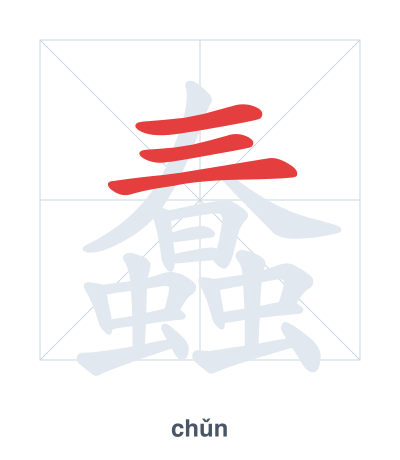
Open Hanzi Writer to see the animated stroke order and practice writing 蠢 with real-time feedback.
The character 蠢 (chǔn) is written with 21 strokes. Follow the standard Chinese stroke order: top to bottom, left to right, outside before inside. The radical 虫 is one of its key components.
Practice the correct stroke order with the Hanzi Writer app to see animated stroke-by-stroke guidance with real-time feedback.
蠢 means Stupid / Clumsy.
As an HSK Level 7 character, 蠢 is an intermediate-level character.
蠢 combines 春 (spring) and 虫 (insect), originally depicting insects stirring and wriggling in spring, which later extended to mean clumsy or stupid behavior like that of dazed insects.
💡 Memory Tip: Imagine insects (虫) emerging in spring (春) moving so slowly and clumsily that they seem stupid.
别做蠢事。
bié zuò chǔn shì
Don't do anything stupid.
这个想法很愚蠢。
zhè ge xiǎng fǎ hěn yú chǔn
This idea is very stupid.
敌人正在蠢动。
dí rén zhèng zài chǔn dòng
The enemy is making a move.
Open Hanzi Writer to see the animated stroke order and practice writing 蠢 with real-time feedback.
✨ Animated stroke order · Handwriting recognition · HSK-graded practice · Free to use
蠢 is made of 春 (spring) on top and 䖵 (two insects) below. Originally it described insects stirring in spring, which led to the meanings of "clumsy" or "stupid" because of slow, wiggly movements.