昧 (mèi) means "Obscure / Ignorant" in Chinese. It has 9 strokes with the radical 日, and is HSK Level 7.
Rated 4/5 in difficulty (challenging).
Harder than 41% of HSK Level 7 characters.
Appears in 3+ common words including 暧昧 (ài mèi), 冒昧 (mào mèi), 愚昧 (yú mèi).
Due to its 9 strokes, Hanzi Writer's error detection shows 昧 requires focused practice — most learners need 10+ attempts for consistent accuracy.
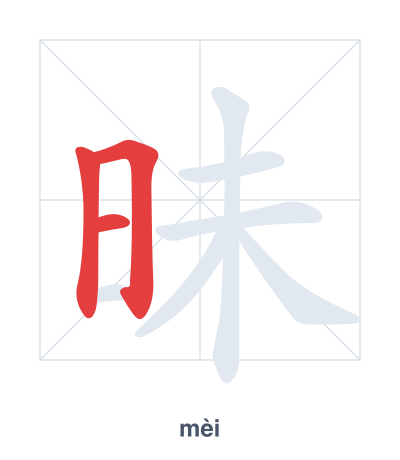
Open Hanzi Writer to see the animated stroke order and practice writing 昧 with real-time feedback.
The character 昧 (mèi) is written with 9 strokes. Follow the standard Chinese stroke order: top to bottom, left to right, outside before inside. The radical 日 is one of its key components.
Practice the correct stroke order with the Hanzi Writer app to see animated stroke-by-stroke guidance with real-time feedback.
昧 means Obscure / Ignorant.
As an HSK Level 7 character, 昧 is an intermediate-level character.
昧 is compound: 日 (sun) + 未 (not yet). The sun has not yet risen, so it is still dark—hence 'obscure' or 'ignorant' (like being in the dark).
💡 Memory Tip: The sun (日) hasn't (未) come up yet, so you're stumbling around in the dark, completely ignorant.
他们的关系很暧昧。
tā men de guān xì hěn ài mèi
Their relationship is ambiguous.
我冒昧地问一个问题。
wǒ mào mèi dì wèn yí gè wèn tí
I'll take the liberty of asking a question.
我们不能太愚昧。
wǒ men bù néng tài yú mèi
We cannot be too ignorant.
Open Hanzi Writer to see the animated stroke order and practice writing 昧 with real-time feedback.
✨ Animated stroke order · Handwriting recognition · HSK-graded practice · Free to use
昧 is composed of the radical 日 (sun/day) on the left and 未 (wèi, not yet) on the right. The sun not yet risen suggests darkness or obscurity, which connects to the meanings of "obscure" and "ignorant."