诱 (yòu) means "to lure" in Chinese. It has 9 strokes with the radical 讠, and is HSK Level 7.
Rated 3.7/5 in difficulty (challenging).
Harder than 31% of HSK Level 7 characters.
Appears in 3+ common words including 诱人 (yòu rén), 诱导 (yòu dǎo), 诱惑 (yòu huò).
Due to its 9 strokes, Hanzi Writer's error detection shows 诱 requires focused practice — most learners need 10+ attempts for consistent accuracy.
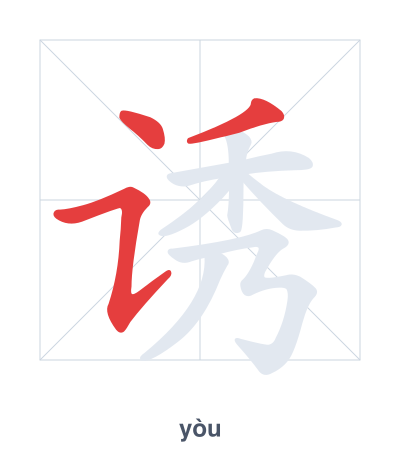
Open Hanzi Writer to see the animated stroke order and practice writing 诱 with real-time feedback.
The character 诱 (yòu) is written with 9 strokes. Follow the standard Chinese stroke order: top to bottom, left to right, outside before inside. The radical 讠 is one of its key components.
Practice the correct stroke order with the Hanzi Writer app to see animated stroke-by-stroke guidance with real-time feedback.
诱 means to lure.
As an HSK Level 7 character, 诱 is an intermediate-level character.
The character 诱 is a phono-semantic compound. The radical 讠 (words/speech) indicates the action is done through speech, while the component 秀 (elegant, beautiful) originally hinted at the idea of using attractive appearances or fine words to entice someone. Together, it paints the picture of luring or seducing through sweet talk or charm.
💡 Memory Tip: Picture a smooth talker (讠) offering a beautiful flower (秀) to lure you closer.
这里的蛋糕很诱人。
zhè lǐ de dàn gāo hěn yòu rén
The cake here is very tempting.
老师诱导学生思考。
lǎo shī yòu dǎo xué shēng sī kǎo
The teacher guides the students to think.
手机的诱惑很大。
shǒu jī de yòu huò hěn dà
The temptation of mobile phones is great.
Open Hanzi Writer to see the animated stroke order and practice writing 诱 with real-time feedback.
✨ Animated stroke order · Handwriting recognition · HSK-graded practice · Free to use
The character 诱 has the radical 讠, meaning speech or words, on the left. The right side 秀 means elegant or beautiful, so together they suggest using elegant words to lure or tempt someone.