咏 (yǒng) means "to chant; to sing" in Chinese. It has 8 strokes with the radical 口, and is HSK Level 7.
Rated 3.7/5 in difficulty (challenging).
Harder than 23% of HSK Level 7 characters.
Appears in 3+ common words including 咏唱 (yǒng chàng), 歌咏 (gē yǒng), 咏叹调 (yǒng tàn diào).
Due to its 8 strokes, Hanzi Writer's error detection shows 咏 requires focused practice — most learners need 10+ attempts for consistent accuracy.
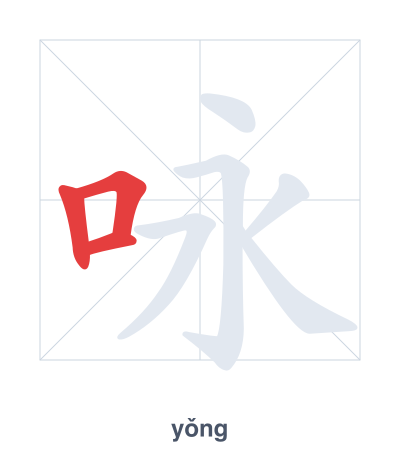
Open Hanzi Writer to see the animated stroke order and practice writing 咏 with real-time feedback.
The character 咏 (yǒng) is written with 8 strokes. Follow the standard Chinese stroke order: top to bottom, left to right, outside before inside. The radical 口 is one of its key components.
Practice the correct stroke order with the Hanzi Writer app to see animated stroke-by-stroke guidance with real-time feedback.
咏 means to chant; to sing.
As an HSK Level 7 character, 咏 is an intermediate-level character.
咏 is a compound character with the radical 口 (mouth) indicating that the meaning relates to vocal action, and the phonetic component 永 (yǒng, meaning 'eternal' or 'long') contributing sound and a hint of duration. Together, they suggest using the mouth to produce a sustained, flowing sound—to chant or sing.
💡 Memory Tip: Imagine a singer with a wide-open mouth (口) holding a long, eternal note (永) in a song.
她在台上咏唱。
tā zài tái shàng yǒng chàng
She is singing on stage.
学校有歌咏比赛。
xué xiào yǒu gē yǒng bǐ sài
The school has a singing competition.
她在唱咏叹调。
tā zài chàng yǒng tàn diào
She is singing an aria.
Open Hanzi Writer to see the animated stroke order and practice writing 咏 with real-time feedback.
✨ Animated stroke order · Handwriting recognition · HSK-graded practice · Free to use
The character 咏 has the radical 口 (mouth) on the left and 永 (yǒng, meaning forever) on the right. The mouth radical suggests an action done with the mouth, like chanting or singing, while 永 provides the pronunciation and adds a sense of flowing or continuous sound.