唱 (chàng) means "to sing" in Chinese. It has 11 strokes with the radical 口, and is HSK Level 1.
Rated 3.7/5 in difficulty (challenging).
Harder than 84% of HSK Level 1 characters.
Appears in 3+ common words including 唱歌 (chàng gē), 唱片 (chàng piàn), 合唱 (hé chàng).
Due to its 11 strokes, Hanzi Writer's error detection shows 唱 requires focused practice — most learners need 10+ attempts for consistent accuracy.
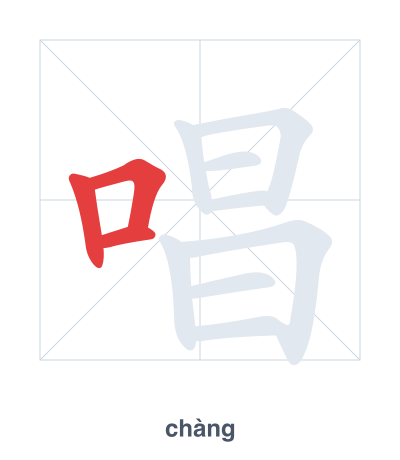
Open Hanzi Writer to see the animated stroke order and practice writing 唱 with real-time feedback.
The character 唱 (chàng) is written with 11 strokes. Follow the standard Chinese stroke order: top to bottom, left to right, outside before inside. The radical 口 is one of its key components.
Practice the correct stroke order with the Hanzi Writer app to see animated stroke-by-stroke guidance with real-time feedback.
唱 means to sing.
As an HSK Level 1 character, 唱 is among the first characters beginners learn.
唱 combines the mouth radical 口 (speaking/singing) with the phonetic component 昌 (chāng, meaning 'bright' or 'prosperous' as two suns). Together, they evoke the image of singing with a bright, clear voice, as if the sound itself radiates sunlight.
💡 Memory Tip: Picture a singer opening their mouth (口) wide while two suns (昌) rise from their throat, illuminating the song.
他很喜欢唱歌。
tā hěn xǐ huān chàng gē
He likes singing very much.
这是一张老唱片。
zhè shì yī zhāng lǎo chàng piàn
This is an old record.
我们参加合唱团。
wǒ men cān jiā hé chàng tuán
We are joining the choir.
Open Hanzi Writer to see the animated stroke order and practice writing 唱 with real-time feedback.
✨ Animated stroke order · Handwriting recognition · HSK-graded practice · Free to use
唱 is made of the radical 口 (mouth) on the left and the phonetic component 昌 (chāng) on the right. The mouth radical shows that singing uses the mouth, while 昌 gives the pronunciation and suggests a clear, pleasant sound like sunlight repeated twice.