硬 (yìng) means "hard" in Chinese. It has 12 strokes with the radical 石, and is HSK Level 5.
Rated 4.2/5 in difficulty (advanced).
Harder than 84% of HSK Level 5 characters.
Appears in 3+ common words including 硬座 (yìng zuò), 坚硬 (jiān yìng), 硬件 (yìng jiàn).
Due to its 12 strokes, Hanzi Writer's error detection shows 硬 requires focused practice — most learners need 10+ attempts for consistent accuracy.
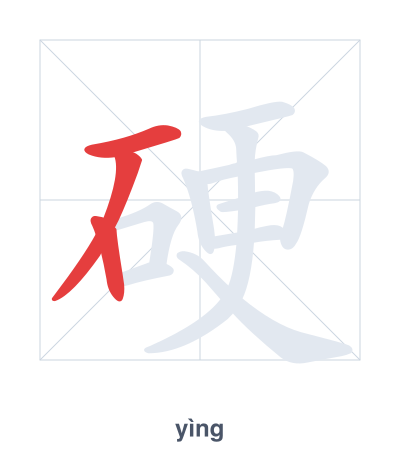
Open Hanzi Writer to see the animated stroke order and practice writing 硬 with real-time feedback.
The character 硬 (yìng) is written with 12 strokes. Follow the standard Chinese stroke order: top to bottom, left to right, outside before inside. The radical 石 is one of its key components.
Practice the correct stroke order with the Hanzi Writer app to see animated stroke-by-stroke guidance with real-time feedback.
硬 means hard.
As an HSK Level 5 character, 硬 is an intermediate-level character.
硬 is a phono-semantic compound: the radical 石 (stone) suggests hardness, while 更 (gèng) provides the pronunciation and also implies 'even more'—together meaning 'as hard as stone, or even harder.'
💡 Memory Tip: Picture a stone (石) being hit with a hammer and becoming even harder (更), so it's 硬 (yìng).
我买了硬座票。
wǒ mǎi le yìng zuò piào
I bought a hard seat ticket.
这块石头很坚硬。
zhè kuài shí tou hěn jiān yìng
This stone is very hard.
电脑的硬件坏了。
diàn nǎo de yìng jiàn huài le
The computer hardware is broken.
Open Hanzi Writer to see the animated stroke order and practice writing 硬 with real-time feedback.
✨ Animated stroke order · Handwriting recognition · HSK-graded practice · Free to use
The character 硬 combines the radical 石 (stone) on the left with 更 (gèng, meaning 'more' or 'change') on the right. The stone radical directly suggests hardness, while 更 provides the sound and reinforces the idea of something 'even more' solid. Together, they create the meaning 'hard' or 'stiff.'