砝 (fá) means "Weight (used in 砝码)" in Chinese. It has 10 strokes with the radical 石.
Rated 4.2/5 in difficulty (advanced).
Appears in 3+ common words including 砝码 (fá mǎ), 砝码盘 (fá mǎ pán), 砝码盒 (fá mǎ hé).
Due to its 10 strokes, Hanzi Writer's error detection shows 砝 requires focused practice — most learners need 10+ attempts for consistent accuracy.
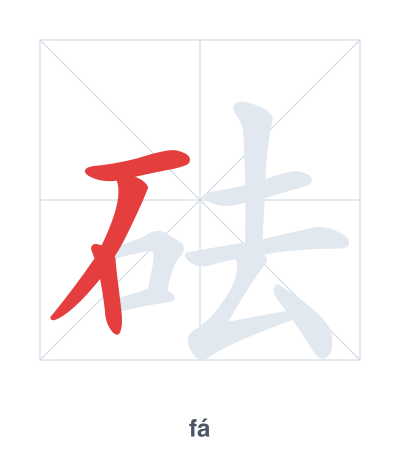
Open Hanzi Writer to see the animated stroke order and practice writing 砝 with real-time feedback.
The character 砝 (fá) is written with 10 strokes. Follow the standard Chinese stroke order: top to bottom, left to right, outside before inside. The radical 石 is one of its key components.
Practice the correct stroke order with the Hanzi Writer app to see animated stroke-by-stroke guidance with real-time feedback.
砝 means Weight (used in 砝码).
砝 is a compound character. The radical 石 (stone) indicates that weights were historically made of stone. The right side 法 (fǎ, meaning 'law' or 'standard') gives a clue to the pronunciation and suggests that a weight must conform to a standard measure.
💡 Memory Tip: Picture a stone (石) being molded into a precise weight by a lawgiver (法) holding a ruler.
天平上放着一个小砝码。
tiān píng shàng fàng zhe yí gè xiǎo fá mǎ
A small weight is placed on the scale.
请把砝码放在砝码盘里。
qǐng bǎ fá mǎ fàng zài fá mǎ pán lǐ
Please put the weights in the weight tray.
砝码盒里有很多砝码。
fá mǎ hé lǐ yǒu hěn duō fá mǎ
There are many weights in the weight box.
Open Hanzi Writer to see the animated stroke order and practice writing 砝 with real-time feedback.
✨ Animated stroke order · Handwriting recognition · HSK-graded practice · Free to use
砝 is made of 石 (stone) on the left and 去 (to go) on the right. The stone radical suggests the character relates to a stone material, which historically was used to make weights. The right part 去 mainly provides the pronunciation fá, though its meaning of "to go" is not directly connected.