矻 (kū) means "to toil; to work hard" in Chinese. It has 8 strokes with the radical 石.
Rated 3.7/5 in difficulty (challenging).
Appears in 3+ common words including 矻矻 (kū kū), 矻蹬 (kū dēng), 矻扎 (kū zhā).
Due to its 8 strokes, Hanzi Writer's error detection shows 矻 requires focused practice — most learners need 10+ attempts for consistent accuracy.
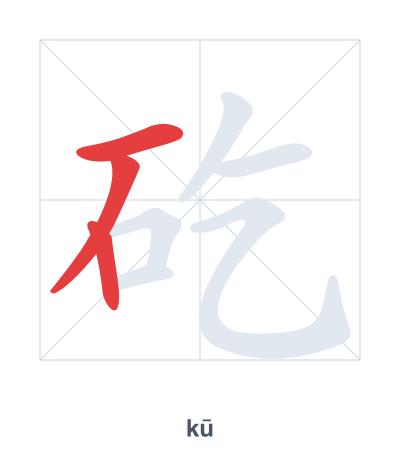
Open Hanzi Writer to see the animated stroke order and practice writing 矻 with real-time feedback.
The character 矻 (kū) is written with 8 strokes. Follow the standard Chinese stroke order: top to bottom, left to right, outside before inside. The radical 石 is one of its key components.
Practice the correct stroke order with the Hanzi Writer app to see animated stroke-by-stroke guidance with real-time feedback.
矻 means to toil; to work hard.
矻 is a compound character where 石 (stone) indicates a connection to hardness or labor, and 乞 (qǐ, to beg) provides the sound. Together, they evoke the image of begging for strength while toiling away at a hard stone, symbolizing strenuous effort.
💡 Memory Tip: Picture a worker begging (乞) for a break while pushing a heavy stone (石), embodying the toil of endless labor.
他整天矻矻地学习。
tā zhěng tiān kū kū dì xué xí
He studies diligently and tirelessly all day long.
走路发出矻蹬声。
zǒu lù fā chū kū dēng shēng
Making a clattering sound while walking.
矻扎一声响。
kū zhā yī shēng xiǎng
There was a cracking sound.
Open Hanzi Writer to see the animated stroke order and practice writing 矻 with real-time feedback.
✨ Animated stroke order · Handwriting recognition · HSK-graded practice · Free to use
矻 is made of the radical 石 (stone) on the left and the component 乞 (to beg) on the right. The stone radical suggests something solid or related to hard physical labor, which connects to the meaning of toiling or working hard. Although 乞 is not directly related to the meaning, it provides a phonetic hint (kū) and completes the character.