砟 (zhǎ) means "Fragments / Cinders" in Chinese. It has 10 strokes with the radical 石.
Rated 4.2/5 in difficulty (advanced).
Appears in 3+ common words including 煤砟子 (méi zhǎ zi), 石砟 (shí zhǎ), 砟子 (zhǎ zi).
Due to its 10 strokes, Hanzi Writer's error detection shows 砟 requires focused practice — most learners need 10+ attempts for consistent accuracy.
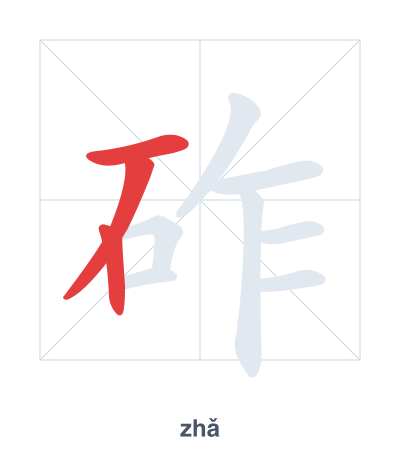
Open Hanzi Writer to see the animated stroke order and practice writing 砟 with real-time feedback.
The character 砟 (zhǎ) is written with 10 strokes. Follow the standard Chinese stroke order: top to bottom, left to right, outside before inside. The radical 石 is one of its key components.
Practice the correct stroke order with the Hanzi Writer app to see animated stroke-by-stroke guidance with real-time feedback.
砟 means Fragments / Cinders.
砟 combines the radical 石 (stone) with the phonetic component 乍 (zhà), meaning 'suddenly' or 'for the first time'. The character suggests stone that has been suddenly broken into small pieces, like fragments or cinders. It is commonly used for coal cinders or rock debris.
💡 Memory Tip: Imagine a stone (石) that suddenly (乍) explodes into countless tiny fragments (砟).
地上到处是煤砟子。
dì shàng dào chù shì méi zhǎ zi
Coal cinders are scattered everywhere on the ground.
铁路边铺满了石砟。
tiě lù biān pù mǎn le shí zhǎ
The railway side is covered with ballast.
小心脚下的石砟子。
xiǎo xīn jiǎo xià de shí zhǎ zi
Watch out for the stone fragments under your feet.
Open Hanzi Writer to see the animated stroke order and practice writing 砟 with real-time feedback.
✨ Animated stroke order · Handwriting recognition · HSK-graded practice · Free to use
砟 is a left-right character. The left side, 石 (stone), suggests the character relates to stone or rock, while the right side, 乍 (at first), provides the pronunciation zhǎ. The combination of stone and fragments gives the meaning of cinders or small broken pieces.