砣 (tuó) means "Steelyard weight" in Chinese. It has 10 strokes with the radical 石.
Rated 4.2/5 in difficulty (advanced).
Appears in 3+ common words including 秤砣 (chèng tuó), 砣子 (tuó zi), 秤砣重 (chèng tuó zhòng).
Due to its 10 strokes, Hanzi Writer's error detection shows 砣 requires focused practice — most learners need 10+ attempts for consistent accuracy.
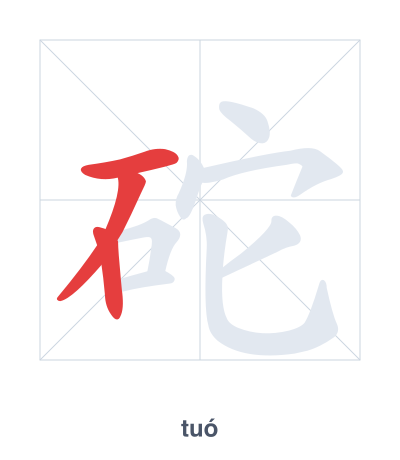
Open Hanzi Writer to see the animated stroke order and practice writing 砣 with real-time feedback.
The character 砣 (tuó) is written with 10 strokes. Follow the standard Chinese stroke order: top to bottom, left to right, outside before inside. The radical 石 is one of its key components.
Practice the correct stroke order with the Hanzi Writer app to see animated stroke-by-stroke guidance with real-time feedback.
砣 means Steelyard weight.
砣 is a phono-semantic compound: the radical 石 (stone) indicates the material of the object, and 它 (tuó) provides the phonetic clue. Historically, steelyard weights were often made of stone or metal, so the character visually represents a stone (石) used as a movable weight on a balance scale.
💡 Memory Tip: Imagine a stone (石) tied to a snake (它) that slithers onto a scale to weigh your groceries—the snake's weight equals exactly one 砣.
卖菜的人拿着秤砣。
mài cài de rén ná zhe chèng tuó
The vegetable seller is holding a scale weight.
这个砣子很沉。
zhè ge tuó zi hěn chén
This weight is very heavy.
秤砣比想象中要重。
chèng tuó bǐ xiǎng xiàng zhōng yào zhòng
The steelyard weight is heavier than expected.
Open Hanzi Writer to see the animated stroke order and practice writing 砣 with real-time feedback.
✨ Animated stroke order · Handwriting recognition · HSK-graded practice · Free to use
砣 is composed of the radical 石 (stone) on the left and 它 (tuō, 'it' or a phonetic component) on the right. The radical 石 indicates that the character relates to stone or heavy objects, while 它 provides the pronunciation tuó. Together, they form the meaning 'steelyard weight,' which was traditionally made of stone or metal.