码 (mǎ) means "yard (unit of length); code; to pile up" in Chinese. It has 8 strokes with the radical 石, and is HSK Level 4.
Rated 3.7/5 in difficulty (challenging).
Harder than 48% of HSK Level 4 characters.
Appears in 3+ common words including 号码 (hào mǎ), 密码 (mì mǎ), 二维码 (èr wéi mǎ).
Due to its 8 strokes, Hanzi Writer's error detection shows 码 requires focused practice — most learners need 10+ attempts for consistent accuracy.
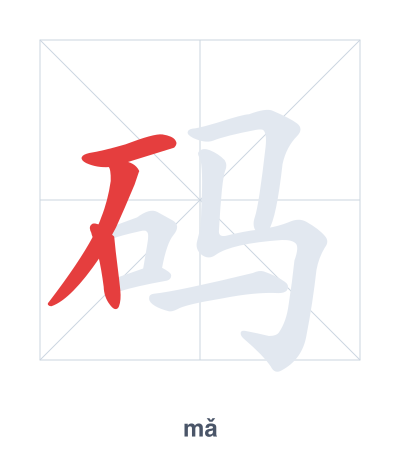
Open Hanzi Writer to see the animated stroke order and practice writing 码 with real-time feedback.
The character 码 (mǎ) is written with 8 strokes. Follow the standard Chinese stroke order: top to bottom, left to right, outside before inside. The radical 石 is one of its key components.
Practice the correct stroke order with the Hanzi Writer app to see animated stroke-by-stroke guidance with real-time feedback.
码 means yard (unit of length); code; to pile up.
As an HSK Level 4 character, 码 is an intermediate-level character.
码 combines the radical 石 (stone) with the phonetic 马 (horse). Originally it denoted a stone marker for distance or weight, which evolved into the modern meanings of a unit of length (yard), a system of symbols (code), and the action of stacking items (to pile up).
💡 Memory Tip: Picture a stone horse (石+马) that stands exactly one yard tall and holds a secret code in its hoof.
你的电话号码是多少?
nǐ de diàn huà hào mǎ shì duō shǎo
What is your phone number?
我忘记了密码。
wǒ wàng jì le mì mǎ
I forgot the password.
请扫一下二维码。
qǐng sǎo yī xià èr wéi mǎ
Please scan the QR code.
Open Hanzi Writer to see the animated stroke order and practice writing 码 with real-time feedback.
✨ Animated stroke order · Handwriting recognition · HSK-graded practice · Free to use
码 is made of the radical 石 (stone) on the left and the component 马 (mǎ, horse) on the right. The radical suggests a connection to stone or objects, while the phonetic part 马 hints at the pronunciation mǎ. Historically, 码 related to stone weights used for measurement, which evolved into meanings like "yard" and "code."