隐 (yǐn) means "hidden; concealed" in Chinese. It has 11 strokes with the radical 阝, and is HSK Level 6.
Rated 3.9/5 in difficulty (challenging).
Harder than 43% of HSK Level 6 characters.
Appears in 3+ common words including 隐藏 (yǐn cáng), 隐瞒 (yǐn mán), 隐形 (yǐn xíng).
Due to its 11 strokes, Hanzi Writer's error detection shows 隐 requires focused practice — most learners need 10+ attempts for consistent accuracy.
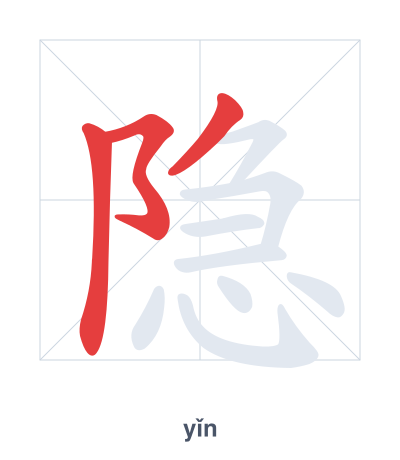
Open Hanzi Writer to see the animated stroke order and practice writing 隐 with real-time feedback.
The character 隐 (yǐn) is written with 11 strokes. Follow the standard Chinese stroke order: top to bottom, left to right, outside before inside. The radical 阝 is one of its key components.
Practice the correct stroke order with the Hanzi Writer app to see animated stroke-by-stroke guidance with real-time feedback.
隐 means hidden; concealed.
As an HSK Level 6 character, 隐 is an intermediate-level character.
The character 隐 combines the radical 阝 (a hill or mound) with a right component that originally pictured a person hiding in a recess. The hill provides a natural place of concealment, while the right side reinforces the idea of being hidden or obscured.
💡 Memory Tip: Picture a hill (阝) with a crouching figure drawn as a bent line and a hand (right side) pulling a blanket over itself to stay hidden.
他隐藏了自己的秘密。
tā yǐn cáng le zì jǐ de mì mì
He hid his secret.
你不应该隐瞒事实。
nǐ bù yīng gāi yǐn mán shì shí
You shouldn't hide the facts.
我今天戴了隐形眼镜。
wǒ jīn tiān dài le yǐn xíng yǎn jìng
I wore contact lenses today.
Open Hanzi Writer to see the animated stroke order and practice writing 隐 with real-time feedback.
✨ Animated stroke order · Handwriting recognition · HSK-graded practice · Free to use
隐 consists of the left radical 阝 (hill) and the right part 匚 (box) plus 工 (work) and 心 (heart). The hill suggests a place of concealment, while the box and heart together imply something hidden inside, connecting to the meaning 'hidden'.