郛 (fú) means "Outer city wall" in Chinese. It has 9 strokes with the radical 阝.
Rated 3.7/5 in difficulty (challenging).
Appears in 3+ common words including 郛郭 (fú guō), 郛外 (fú wài), 郛内 (fú nèi).
Due to its 9 strokes, Hanzi Writer's error detection shows 郛 requires focused practice — most learners need 10+ attempts for consistent accuracy.
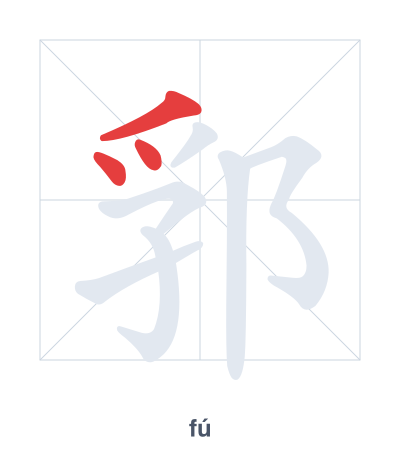
Open Hanzi Writer to see the animated stroke order and practice writing 郛 with real-time feedback.
The character 郛 (fú) is written with 9 strokes. Follow the standard Chinese stroke order: top to bottom, left to right, outside before inside. The radical 阝 is one of its key components.
Practice the correct stroke order with the Hanzi Writer app to see animated stroke-by-stroke guidance with real-time feedback.
郛 means Outer city wall.
郛 is a phono-semantic compound character. The left side, 阝 (city wall), indicates the meaning of an outer defensive wall, while the right side, 孚 (fú), provides the pronunciation and originally depicted a hand grasping a child, but here it serves only as a phonetic component.
💡 Memory Tip: Imagine a child (子) using his little hand (爫) to build an outer city wall (阝) around his toy castle.
这里的郛郭很古老。
zhè lǐ de fú guō hěn gǔ lǎo
The outer city walls here are very ancient.
他住在郛外的小村子。
tā zhù zài fú wài de xiǎo cūn zi
He lives in a small village outside the outer city wall.
郛内有很多商店。
fú nèi yǒu hěn duō shāng diàn
There are many shops inside the outer city wall.
Open Hanzi Writer to see the animated stroke order and practice writing 郛 with real-time feedback.
✨ Animated stroke order · Handwriting recognition · HSK-graded practice · Free to use
郛 is made of the radical 阝 (meaning "place" or "city") on the left and 孚 (fú, meaning "to trust" but here used phonetically) on the right. The radical gives the meaning of a city-related structure, while 孚 provides the sound. Together they form the idea of an "outer city wall."