郜 (gào) means "Gao (a surname)" in Chinese. It has 9 strokes with the radical 阝.
Rated 3.7/5 in difficulty (challenging).
Appears in 3+ common words including 郜先生 (gào xiān shēng), 郜老师 (gào lǎo shī), 姓郜 (xìng gào).
Due to its 9 strokes, Hanzi Writer's error detection shows 郜 requires focused practice — most learners need 10+ attempts for consistent accuracy.
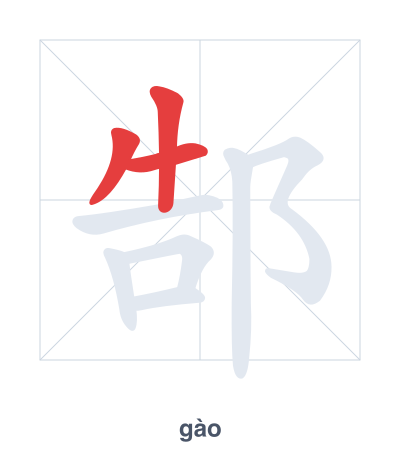
Open Hanzi Writer to see the animated stroke order and practice writing 郜 with real-time feedback.
The character 郜 (gào) is written with 9 strokes. Follow the standard Chinese stroke order: top to bottom, left to right, outside before inside. The radical 阝 is one of its key components.
Practice the correct stroke order with the Hanzi Writer app to see animated stroke-by-stroke guidance with real-time feedback.
郜 means Gao (a surname).
郜 is a phono-semantic compound combining the radical 阝 (right version, meaning 'city') with 告 (gào, 'to tell'), which gives the sound. Originally it referred to a place name in ancient China, likely a city-state or fief, and later became a surname. The left component 告 depicts a hand putting a message into a mouth, suggesting announcements, while the right radical marks it as a location.
💡 Memory Tip: Imagine a city (阝) crier shouting announcements (告) — that's the city of Gao (郜).
郜先生是我的邻居。
gào xiān shēng shì wǒ de lín jū
Mr. Gao is my neighbor.
郜老师今天没来学校。
gào lǎo shī jīn tiān méi lái xué xiào
Teacher Gao didn't come to school today.
他也姓郜。
tā yě xìng gào
His surname is also Gao.
Open Hanzi Writer to see the animated stroke order and practice writing 郜 with real-time feedback.
✨ Animated stroke order · Handwriting recognition · HSK-graded practice · Free to use
郜 is made of two parts: the left radical 阝 (meaning "town" or "place") and the right part 告 (meaning "to tell" or "announce"). The radical 阝 indicates this character is related to a place name or region, and 告 gives the pronunciation gào. This structure is common for Chinese surnames that originally came from ancient place names.