妊 (rèn) means "To be pregnant" in Chinese. It has 7 strokes with the radical 女.
Rated 3.5/5 in difficulty (challenging).
Appears in 3+ common words including 妊娠 (rèn shēn), 妊妇 (rèn fù), 受妊 (shòu rèn).
Due to its 7 strokes, Hanzi Writer's error detection shows 妊 requires focused practice — most learners need 10+ attempts for consistent accuracy.
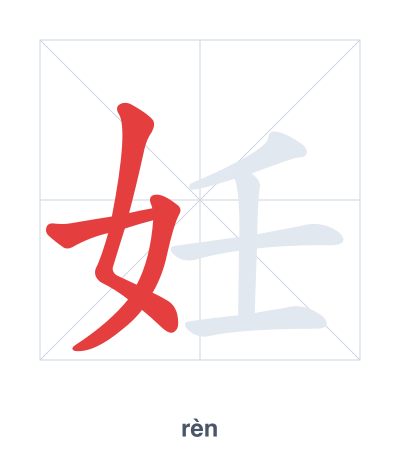
Open Hanzi Writer to see the animated stroke order and practice writing 妊 with real-time feedback.
The character 妊 (rèn) is written with 7 strokes. Follow the standard Chinese stroke order: top to bottom, left to right, outside before inside. The radical 女 is one of its key components.
Practice the correct stroke order with the Hanzi Writer app to see animated stroke-by-stroke guidance with real-time feedback.
妊 means To be pregnant.
The character 妊 combines the radical 女 (woman) with the phonetic component 壬 (rén). 壬 originally depicted a person carrying a burden, thus together they convey the idea of a woman carrying a child—i.e., being pregnant.
💡 Memory Tip: A woman (女) with a big, rounded belly (like the shape of 壬) is clearly pregnant.
她正在妊娠期。
tā zhèng zài rèn shēn qī
She is currently pregnant.
这里的妊妇很多。
zhè lǐ de rèn fù hěn duō
There are many pregnant women here.
她成功受妊了。
tā chéng gōng shòu rèn le
She has successfully conceived.
Open Hanzi Writer to see the animated stroke order and practice writing 妊 with real-time feedback.
✨ Animated stroke order · Handwriting recognition · HSK-graded practice · Free to use
The character 妊 is composed of the radical 女 (woman) on the left and the component 壬 on the right. 女 directly indicates that the meaning relates to women, while 壬 provides the pronunciation (rèn) and also visually suggests a belly or bearing a child, which together express the concept of pregnancy.