妒 (dù) means "Jealous" in Chinese. It has 7 strokes with the radical 女, and is HSK Level 7.
Rated 3.5/5 in difficulty (challenging).
Harder than 16% of HSK Level 7 characters.
Appears in 3+ common words including 嫉妒 (jí dù), 妒忌 (dù jì), 妒火 (dù huǒ).
Due to its 7 strokes, Hanzi Writer's error detection shows 妒 requires focused practice — most learners need 10+ attempts for consistent accuracy.
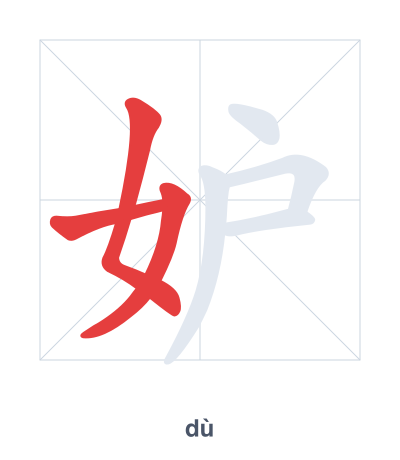
Open Hanzi Writer to see the animated stroke order and practice writing 妒 with real-time feedback.
The character 妒 (dù) is written with 7 strokes. Follow the standard Chinese stroke order: top to bottom, left to right, outside before inside. The radical 女 is one of its key components.
Practice the correct stroke order with the Hanzi Writer app to see animated stroke-by-stroke guidance with real-time feedback.
妒 means Jealous.
As an HSK Level 7 character, 妒 is an intermediate-level character.
妒 is a compound character: the radical 女 (woman) indicates the subject, and 户 (door/house) originally provided phonetic value while also suggesting a woman guarding her household, an act often linked to jealousy in ancient texts.
💡 Memory Tip: Picture a jealous woman (女) slamming her door (户) shut because she can't stand seeing her neighbor's success.
不要嫉妒别人。
bú yào jí dù bié rén
Don't be jealous of others.
他心里很妒忌。
tā xīn lǐ hěn dù jì
He was very jealous.
她心中燃起妒火。
tā xīn zhōng rán qǐ dù huǒ
Jealousy flared up in her heart.
Open Hanzi Writer to see the animated stroke order and practice writing 妒 with real-time feedback.
✨ Animated stroke order · Handwriting recognition · HSK-graded practice · Free to use
The character 妒 is composed of the radical 女 (woman) on the left and the component 户 (door) on the right. While the exact etymology is unclear, the combination of a woman and a door traditionally suggests jealousy arising from private or domestic situations.