纪 (jì) means "Discipline / Record / Era" in Chinese. It has 6 strokes with the radical 纟, and is HSK Level 3.
Rated 3.2/5 in difficulty (challenging).
Harder than 32% of HSK Level 3 characters.
Appears in 3+ common words including 纪念 (jì niàn), 纪律 (jì lǜ), 姓纪 (xìng jì).
Due to its 6 strokes, Hanzi Writer's error detection shows 纪 requires focused practice — most learners need 10+ attempts for consistent accuracy.
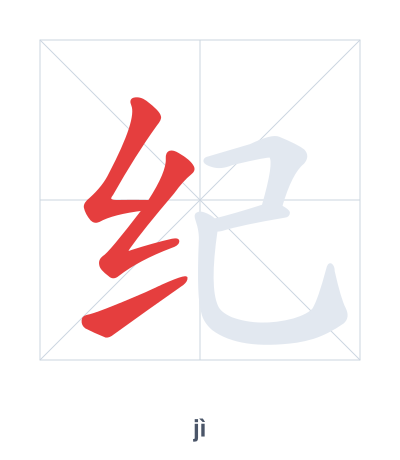
Open Hanzi Writer to see the animated stroke order and practice writing 纪 with real-time feedback.
The character 纪 (jì) is written with 6 strokes. Follow the standard Chinese stroke order: top to bottom, left to right, outside before inside. The radical 纟 is one of its key components.
Practice the correct stroke order with the Hanzi Writer app to see animated stroke-by-stroke guidance with real-time feedback.
纪 means Discipline / Record / Era.
As an HSK Level 3 character, 纪 is an intermediate-level character.
纪 combines the silk radical 纟, representing threads used for recording, with 己 (self), which provides phonetic value and hints at self-discipline. In ancient China, knots on silk cords served as records, so the character evolved to mean 'record,' 'discipline,' or an 'era.'
💡 Memory Tip: Picture tying a silk thread (纟) around your own (己) wrist to remind yourself to record every event with discipline during a new era.
老师建议大家拍照留念,作为对校园生活的纪念。
lǎo shī jiàn yì dà jiā pāi zhào liú niàn zuò wéi duì xiào yuán shēng huó de jì niàn
The teacher suggested everyone take photos as a memento of their campus life.
每一个学生都应当自觉遵守学校的纪律。
měi yí gè xué shēng dōu yīng dāng zì jué zūn shǒu xué xiào de jì lǜ
Every student should consciously abide by the school's discipline.
纪先生是国内非常有名的纪实摄影师。
jì xiān shēng shì guó nèi fēi cháng yǒu míng de jì shí shè yǐng shī
Mr. Ji is a very famous documentary photographer in the country.
Open Hanzi Writer to see the animated stroke order and practice writing 纪 with real-time feedback.
✨ Animated stroke order · Handwriting recognition · HSK-graded practice · Free to use
The character 纪 is composed of the radical 纟 (silk) on the left and 己 (self) on the right. The silk radical suggests threads used for tying or recording, while 己 provides the sound and can hint at self-discipline. Together they form meanings like "to record" (tying notes) and "discipline" (binding oneself).