羊 (yáng) means "Sheep; goat" in Chinese. It has 6 strokes with the radical 羊, and is HSK Level 3.
Rated 2.9/5 in difficulty (moderate).
Harder than 25% of HSK Level 3 characters.
Appears in 3+ common words including 山羊 (shān yáng), 羊肉 (yáng ròu), 绵羊 (mián yáng).
Hanzi Writer's stroke validation shows learners typically need 5-8 attempts to write 羊 with correct proportion and order.
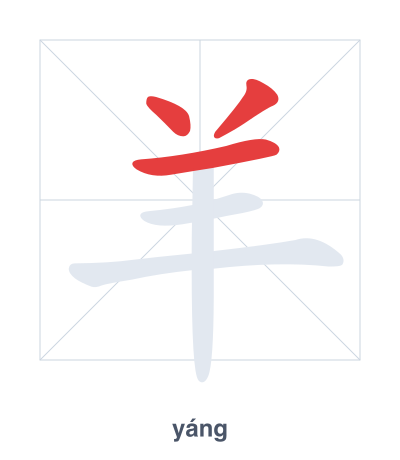
Open Hanzi Writer to see the animated stroke order and practice writing 羊 with real-time feedback.
The character 羊 (yáng) is written with 6 strokes. Follow the standard Chinese stroke order: top to bottom, left to right, outside before inside. The radical 羊 is one of its key components.
Practice the correct stroke order with the Hanzi Writer app to see animated stroke-by-stroke guidance with real-time feedback.
羊 means Sheep; goat.
As an HSK Level 3 character, 羊 is an intermediate-level character.
羊 is a pictograph of a sheep's head, with ancient oracle bone script showing curved horns and a face. The modern shape retains the head with two horns (top strokes) and a snout (vertical line).
💡 Memory Tip: Imagine the top two strokes as curled sheep horns, the three horizontal lines as its fluffy body, and the vertical stroke as its sturdy leg.
山上有几只山羊。
shān shàng yǒu jǐ zhī shān yáng
There are a few mountain goats on the mountain.
我喜欢吃烤羊肉。
wǒ xǐ huān chī kǎo yáng ròu
I like eating roasted lamb.
绵羊的毛很软。
mián yáng de máo hěn ruǎn
Sheep's wool is very soft.
Open Hanzi Writer to see the animated stroke order and practice writing 羊 with real-time feedback.
✨ Animated stroke order · Handwriting recognition · HSK-graded practice · Free to use
羊 is a pictograph of a sheep's head with horns. The top part represents the horns, the horizontal line is the head, and the bottom is the body. This simple shape directly depicts a sheep or goat.