羍 (dá) means "Lamb" in Chinese. It has 9 strokes with the radical 羊.
Rated 4/5 in difficulty (challenging).
Appears in 3+ common words including 羍子 (dá zi), 羔羍 (gāo dá), 羍羊 (dá yáng).
Due to its 9 strokes, Hanzi Writer's error detection shows 羍 requires focused practice — most learners need 10+ attempts for consistent accuracy.
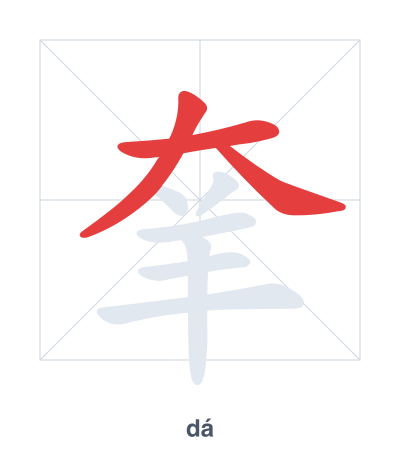
Open Hanzi Writer to see the animated stroke order and practice writing 羍 with real-time feedback.
The character 羍 (dá) is written with 9 strokes. Follow the standard Chinese stroke order: top to bottom, left to right, outside before inside. The radical 羊 is one of its key components.
Practice the correct stroke order with the Hanzi Writer app to see animated stroke-by-stroke guidance with real-time feedback.
羍 means Lamb.
| Character | 羍 |
| Pinyin | dá (da) |
| Meaning | Lamb |
| Strokes | 9 |
| Radical | 羊 |
| Difficulty | 4/5 |
羍 is a compound character combining the radical 羊 (sheep) with 大 (big). The 大 component serves as a phonetic hint (pronounced dá), while the overall form depicts a lamb, a young sheep. In some interpretations, the 大 may also suggest the lamb is 'big' relative to its newborn size.
💡 Memory Tip: Picture a giant (大) sheep (羊) that is actually just an oversized lamb, still bleating like a baby.
羊羔也叫羍子。
yáng gāo yě jiào dá zi
A lamb is also called 'dazi'.
小羊被称为羔羍。
xiǎo yáng bèi chēng wéi gāo dá
A young sheep is called a lamb.
羍羊在草地上。
dá yáng zài cǎo dì shàng
The lamb is on the grass.
Open Hanzi Writer to see the animated stroke order and practice writing 羍 with real-time feedback.
✨ Animated stroke order · Handwriting recognition · HSK-graded practice · Free to use
羍 is composed of two parts: the top part is 大 (dà, 'big') and the bottom is 羊 (yáng, 'sheep'). Together, they suggest a 'big sheep' or a fully grown sheep, which is associated with a lamb. The radical 羊 directly connects to the meaning of sheep or lamb.