美 (měi) means "beautiful" in Chinese. It has 9 strokes with the radical 羊, and is HSK Level 3.
Rated 4/5 in difficulty (challenging).
Harder than 68% of HSK Level 3 characters.
Appears in 3+ common words including 美丽 (měi lì), 美食 (měi shí), 美国 (měi guó).
Due to its 9 strokes, Hanzi Writer's error detection shows 美 requires focused practice — most learners need 10+ attempts for consistent accuracy.
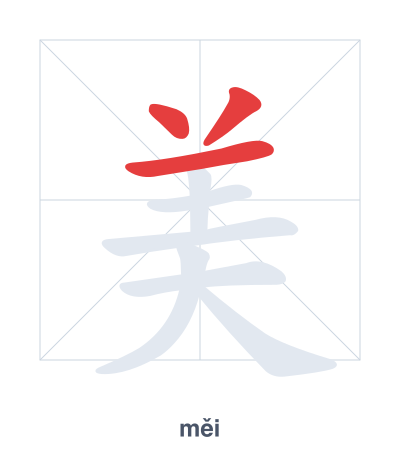
Open Hanzi Writer to see the animated stroke order and practice writing 美 with real-time feedback.
The character 美 (měi) is written with 9 strokes. Follow the standard Chinese stroke order: top to bottom, left to right, outside before inside. The radical 羊 is one of its key components.
Practice the correct stroke order with the Hanzi Writer app to see animated stroke-by-stroke guidance with real-time feedback.
美 means beautiful.
As an HSK Level 3 character, 美 is an intermediate-level character.
美 combines 羊 (sheep) and 大 (big). In ancient China, a large, plump sheep was considered a symbol of beauty and prosperity, so the character literally means 'big sheep' to convey beauty.
💡 Memory Tip: Imagine a sheep with a big, fluffy body (大) that looks so perfect and elegant that everyone calls it beautiful (美).
这里的风景很美丽。
zhè lǐ de fēng jǐng hěn měi lì
The scenery here is very beautiful.
我喜欢吃中国美食。
wǒ xǐ huān chī zhōng guó měi shí
I like eating Chinese cuisine.
他去年去了美国。
tā qù nián qù le měi guó
He went to the United States last year.
Open Hanzi Writer to see the animated stroke order and practice writing 美 with real-time feedback.
✨ Animated stroke order · Handwriting recognition · HSK-graded practice · Free to use
美 is made of two parts: the top is 羊 (sheep) and the bottom is 大 (big). In ancient times, a large, plump sheep was considered beautiful, so the combination of "big sheep" expresses the idea of beauty.