羞 (xiū) means "shy or ashamed" in Chinese. It has 10 strokes with the radical 羊, and is HSK Level 7.
Rated 4.2/5 in difficulty (advanced).
Harder than 81% of HSK Level 7 characters.
Appears in 3+ common words including 害羞 (hài xiū), 羞耻 (xiū chǐ), 羞愧 (xiū kuì).
Due to its 10 strokes, Hanzi Writer's error detection shows 羞 requires focused practice — most learners need 10+ attempts for consistent accuracy.
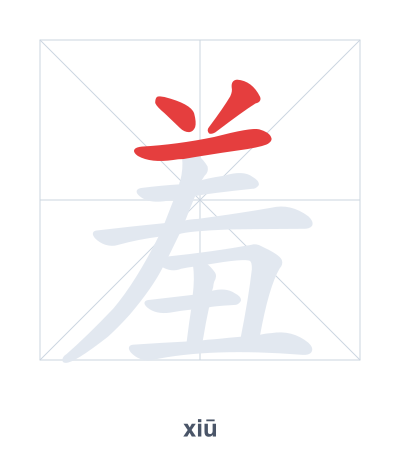
Open Hanzi Writer to see the animated stroke order and practice writing 羞 with real-time feedback.
The character 羞 (xiū) is written with 10 strokes. Follow the standard Chinese stroke order: top to bottom, left to right, outside before inside. The radical 羊 is one of its key components.
Practice the correct stroke order with the Hanzi Writer app to see animated stroke-by-stroke guidance with real-time feedback.
羞 means shy or ashamed.
As an HSK Level 7 character, 羞 is an intermediate-level character.
Originally, 羞 depicted a hand (丑, a variant of 又) holding a sheep (羊), meaning to offer food as a gift. The character later shifted to mean 'shame' or 'shy,' possibly from the embarrassment of being seen as an ugly sheep. Today, the combination of sheep (羊) and ugly (丑) visually suggests feeling shy about one's looks.
💡 Memory Tip: Picture an ugly sheep (羊 + 丑) blushing and hiding its face because it feels shy and ashamed.
那个孩子很害羞。
nà ge hái zi hěn hài xiū
That child is very shy.
他感到很羞耻。
tā gǎn dào hěn xiū chǐ
He felt very ashamed.
我觉得非常羞愧。
wǒ jué de fēi cháng xiū kuì
I feel very ashamed.
Open Hanzi Writer to see the animated stroke order and practice writing 羞 with real-time feedback.
✨ Animated stroke order · Handwriting recognition · HSK-graded practice · Free to use
羞 is composed of 羊 (sheep) on top and 丑 (ugly) below. The sheep radical suggests an offering or ritual, while 丑 (ugly) implies something flawed, together evoking a sense of awkwardness or shame.